Showing posts with label Garden notes. Show all posts

16 Oct 2011

Blog Action Day: food growing links

Today is Blog Action Day on Food. Since 2007, Blog Action Day has focused bloggers around the world to blog about one important global topic on the same day. Past topics have included water, climate change and poverty.Well the day gives me an excuse to revisit our Edible Open Gardens project. It was so successful this year that already plans are afoot for next year.

Our videos of the day have also still getting lots of views - see them here if you haven't yet - several people have passed me links to other useful websites so here goes - thanks to Helen, Jim, Roxanne and The Ruscombe Dreamer for these:

Facebook Backyard and Garden farming, smallholding, homesteading and foraging.
http://www.facebook.com/groups/Backyardfarming/?id=10150373919798619

Eat Weeds - foraging for wild food - an excellent site:
http://www.eatweeds.co.uk/

Self Sufficientish - Forum and huge wealth of information:

http://www.selfsufficientish.com/forum/

Downsizer - aimed at providing info to those on a journey to live more simply and sustainably:
http://www.downsizer.net/

Composting advice - hot and cold:
http://www.gardenorganic.org.uk/composting/compost_2.php

10 Rules for Composting:
http://www.nannypro.com/blog/10-rules-to-remember-about-composting/ 

The film 'Our Daily Bread' - it is very moving, horrific and powerful and enough to make anyone think about where their food comes from: 
http://www.youtube.com/watch?v=QxlquoyqU7M 

And here's an article re storing food which looks at the Mormons policies and how that appears to have led to food waste:
http://www.transitionnetwork.org/blogs/transition-voice/2011-09-16/who-s-storing-food-now

10 Sept 2011

Stroud FM: Gardeners Question Time


It is now Eco-Renovation Open Homes weekend which I am rushing off to help organise - but earlier this year as part of the Edible Open Gardens weekend we organised a Gardeners Question Time on Stroud FM. Well here is a summary of the answers given by Helen Pitel, Jane Brown and Ellen Winter who were our resident experts on the show and Amanda Godber our gardening advisor. You can see the videos of the weekend here and more about the weekend at: http://edibleopengardens.org.uk/

Update Sept 2011: Follow this link, press play, and you can hear the first hour of our
Gardeners' Question Time show recorded earlier this year: http://podcasts.canstream.co.uk/stroud/index.php?cat=The%20Transition%20Show 

1. I have tried year after year for about eleven years to grow parsnips but alas they never germinate, and I have read the books and followed the suggestions, and I've tried in different locations: Bristol, Gloucester and Cainscross. What could be the key thing that I am missing, apart from luck?   

Must have fresh seed from freshly opened packet /sow thinkly / slow to germinate, label them and add date / sew with radishes then you can see them / need thinning / could be problem with slugs / sew in toilet rolls (put screwed up newspaper in bottom, fill with earth. Can be put into ground and toilet roll will decompose) / Water trench/ground before seeds sown and keep moist.

Click Read more to see the other questions

9 Aug 2011

Fruit and veg today has less nutients

There is an interesting article in Grist about how selective breeding of plants means our fruit and veg have changed lots over the last 60 years. The studies show that as fruits and vegetables get bigger and more plentiful, nutrients get diluted. But as the guy says, nutrient depletion pales as a threat when compared to other aspects of our diets like refined sugar, fats, oils, and refined grains over fruits and veggies in the first place. See here.

8 Aug 2011

National Allotment week and edible flowers

Today is the start of National Allotment week (see here). So for this blog I want to re-visit the Whiteshill and Ruscombe Allotments movie with over a 140 views - See this wonderful community project: http://www.youtube.com/watch?v=UnmveLQNX3E 

See also below a great blog by Gem taken from here about edible flowers.  So let all your garden become edible!!

Incr-Edible Flowers

At this time of year, you may like to add variety to your recipes by harvesting flowers from the garden for the dining table. There are more edible flowers than most people realise, so take advantage of nature’s bounty and get picking! Spicy or peppery petals suit being added to salads and garlic butters or used as a garnish for soups and other cooked food while sweet blossoms can be floated in drinks, added to ice cubes or candied to decorate cakes and desserts. Some flowers, particularly courgette and daylily flowers apparently taste great coated in battered and fried up as floral fritters. Obviously, care needs to be taken when deciding which flowers are safe to eat and how to accurately identify them. You’ll also want to ensure that heavy traffic or pesticides haven’t polluted the flowers you pick. I would advise only eating flowers that you’ve specifically grown for the purpose. If you suffer from asthma, hay fever or other allergies, you may want to be extra cautious about eating flowers. In such cases, the petals could be used as a garnish only and not eaten.
The following flowers are all edible as long as you remove the stamens and use only the petals. Herb blossoms aren’t featured here, as there are so many of them but do remember that herbs have tasty flowers as well as leaves. Chive, chamomile, lavender and bergamot flowers are particularly attractive. Click read more to see list.

3 Jul 2011

Garden Notes: July

Here is the last set of my Garden notes...for the other sets click 'Label below and scroll down.

July Notes

Top up ponds and bog gardens in hot weather - thin excess plant growth and remove blanket weed initially to the edge to allow trapped critters to return to the water

Collect horse-manure to bulk up the compost heap

Prop or tie up heavily-laden fruit trees and dispose of fallen fruit which may contain pests

Continue removing side-shoots of tomatoes and thin cucumbers - remove lower leaves of tomatoes only when they go brown or yellow - fully ventilate greenhouse maybe even at nights and dampen floor and staging often - avoid splashing tomato fruits as this can spread botrytis

Soak nettles or comfrey in a water butt for a few days for an excellent liquid manure and feed to tomatoes with a dressing of wood ash. 

Put straw under bush tomatoes to keep fruit clean and raise it above soil level

Continue sowings including early varieties of vegetables - broad beans for their tops which can be cooked like spinach in the autumn while their roots supply nitrogen to the soil

Cut Aquilegia to ground to discourage mildewy leaves and remove main spikes of delphiniums and foxgloves to encourage side shoots to bloom - leaving the best plants to save seed for next year

Harvest garlic when about 4 leaves begin to yellow and harvest globe artichokes while their heads are still small

Dead head to encourage further flowering and take semi-ripe cuttings of shrubs like hebe, choisya, potentilla and spirea

Cut spring flower meadows and remove hay

Summer prune red and white currants and gooseberries

Prune damage or intrusive growth from plums July or August to avoid disease

Pinch out growing point of runner beans when they reach the top of their canes and harvest soft fruit when absolutely ripe for best taste

Earth up and stake large brassicas in exposed sites

Watch for mealy cabbage aphids (waxy grey insects that build up on the underside of leaves & in hearts) and cabbage white eggs and caterpillars

4 Jun 2011

For peat's sake listen!

When will the Government phase out the use of peat in horticulture? The evidence is overwhelming - extracting peat destroys vital wildlife habitats and is responsible for loads of greenhouse gas emissions. Peat bogs are major carbon sinks - some estimate we have lost 95% of them already - when peat is extracted it releases huge amounts of carbon - indeed the peat industry in this country leads to emissions equivalent to 100,000 cars.

What’s more, there are plenty of peat-free alternatives available - and research by 'Which?' found that alternative peat-free compost can outperform the traditional product. Last year the consumer watchdog awarded Best Buys for container compost to three peat-free varieties - Vital Earth Tub and Basket Compost; New Horizon Multi-Purpose Compost; and Vital Earth Multi-Purpose Compost.

The Government even accepts this argument but for some reason is not acting despite even the big gardening businesses wanting action.

For more than ten years we have had a voluntary approach to phasing out peat use, with a target of using 90% peat alternatives by 2010. As RSPB note: "The result has been a spectacular failure - growing media in the UK is still 70% peat!"

Peat-free is currently more expensive than peat and it seems the government is happy for us to continue using it. However with a levy per litre they could move towards a complete phase out.  Garden Organic have launched a pledge for people to sign up to not using peat - that is part of a lobby to get the government to end peat sales by 2016.

1 Jun 2011

Garden Notes: June

Here is the penultimate set of my Garden notes..for the other sets click 'Label below and scroll down.

June Notes

Water priority should be pots and shrubs planted last year, leafy vegetables, tomatoes, beans and peas - courgettes need water once the fruit swells. Don’t waste water on lawns that should green up in the autumn. Water evenings to reduce evaporation. However watering early mornings reduces slug damage significantly. Soak thoroughly once-a-week rather than a daily sprinkle - cut-off plastic bottles sunk in the ground are great for getting water where it is wanted.

Hang nasturtiums in a basket in fruit trees infested with woolly aphids - hoverflies lured to feed will lay eggs and the larvae munch on the aphids

Continue sowings - peas to avoid pea moth, carrots to miss the first carrot root flies - thin out other seedlings - use lettuce and onion seedlings for salads

Remove any flower stalks from rhubarb to increase production or leave for their dramatic display


Continue hand weeding but look out for any self-sown seedlings if they are in the right place you can leave them - water plants after weeding

Plant out brassicas started earlier in pots - look out for cabbage white eggs and caterpillars - remove by hand where practical. Fill space between brassicas with ‘catch’ crops like lettuce

Ventilate greenhouse all night if necessary and damp down to maintain a humid atmosphere - thin cucumbers and feed tomatoes once fruit is the size of marbles and continue removing side shoots and staking plants

Keep making compost - turn the heap to accelerate rotting

Don’t transplant lettuces at this time as they usually run to seed in hot weather

Prune plums and cherries now to avoid silver leaf infection - net fruit against birds and thin all tree fruits after the end of natural drop

Peg down strawberry runners to make new plants

Cut down nettles to encourage ladybirds to move onto other plants - make a liquid feed from the nettles

Take softwood cuttings of shrubs and propagate climbers by layering

16 May 2011

Graduate Gardeners make gold at Malvern

I was fortunate to have the day at the Malvern Spring Gardening Show - never been to such a show before. A little too much consumerism and shopping for my taste but still great fun - and especially enjoyed the two gold winning gardens....Graduate Gardeners of Bisley and Hannah Genders - the latter was particularly good re veg and I am sure such gardens can only encourage folk to grow more.  The video is a little rough as it is only a small digital camera and I haven't quite got the hang of it - but hopefully a flavour of the two gardens.

2 May 2011

Garden Notes: May

 Here is the next set of my Garden notes...it is strange seeing them in the light of the very different dry April we have just had....for the other sets click 'Label below and scroll down - also look out tomorrow for the opening of the Whiteshill and Ruscombe allotments.

May Notes

Plant up baskets and tubs with half-hardy flowers and vegetables but keep inside until the end of the month
 
Bean poles placed wider at the top than the bottom will increase ventilation and ease of picking as the beans hang down on the outside rather than the inside

Check tree ties are not cutting into growing stems and remove grease bands

Continue sowing outside and towards the end of the month plant out tender vegetables and flowers after the risk of frost is past - frost warnings are a useful guide to those willing to take protective measures. Harden-off plants by putting them out during the day and using cloches - brassicas can be planted to the base of the lowest leaf-stalks.

Thin out excessive growth of aquatic plants, continue to remove blanket and duckweed
Mulch fruit and vegetables with straw to smother weeds and retain moisture - particularly good for peas and beans

Remove side-shoots from tomatoes as they appear

Watch out for pests and diseases - pick off aphid infestations; hang pheromone codling moth traps in apple and pear trees until the end of august; remove scab-infected leaves from apples and pears; pick-out tops of flowering broad beans to reduce black fly attack (eat the tops in salads or cook like spinach); protect seed beds from birds

Remove unwanted suckers from raspberries (see left) and artichokes

Apply shading to greenhouse, ensure good ventilation and damp down as necessary - grow French marigolds and basil to reduce white fly and hang up yellow cards or buy predators
Continue to thin-out vegetables & flowers when just big enough to handle and continue hand-weeding regularly - weeds will stem growth of nearby vegetables and fruit

Stake tall herbaceous plants before they grow too big and tie in new growth of climbers - trim where necessary

 Grow squash in deep, rich soil (just got mine from the Whiteshill and Ruscombe Village Party on Friday) - they create a superb ground cover July to October and happily coexist with taller plants like sweetcorn

A look at cucumbers...

If you look closely in my garden later this summer, there will be signs of my deep moral slackness. Bent cucumbers. Yes, to a Victorian grower, a kink in your cue was a sign of loose morals. Indeed they were so concerned that glass tubes were fitted over newly set fruit to ensure they grew straight (see photo). Is this where the EU got their ideas?

Cues, straight or kinked, like warmth and are also partial to plenty of compost around their roots and plenty of water to drink. Avoid wetting young leaves as this causes fungus. I find training the vines up a tripod of canes makes harvesting easier and snipping out the growing tips encourages fruit production.

Harvest the cucumbers young, as they are superior in taste to older cues which may develop some bitterness. The bitterness seems to spread down from the flower end so don’t discard the fruit until you’ve tasted the other end. Indeed don’t discard at all as older cues can be great in a stirfry or curry. 

Or perhaps use them like the Spanish gypsies who put them on bruises. Or chill and slice for wearing over tired eyes as many a beauty magazine suggests. However perhaps avoid Eliza Actons advice, in her 19th century cookery book, in which she recommends boiling cucumbers at length.

2 Apr 2011

Garden Notes: April

Here is the next set of my Garden notes..for the other sets click 'Label' below and scroll down.

April Notes

Sow parsley - according to tradition this is best done on Good Friday - germination is speeded by soaking seeds overnight in warm water - this is also the day to plant main-crop potatoes - plant deep to reduce earthing up

Sow/plant hardy vegetables & flowers outside - don’t forget pot marigolds & poached egg plants for those aphid-eating hoverflies. 

Seed beds will benefit from a soak the day before sowing

In the greenhouse sow tender vegetables such as french & runner beans in deep modules ready to plant out after the risk of frost has passed - also tomatoes, cucumbers etc

Apply pelleted poultry manure to greedy feeders like beetroot, potatoes & larger brassicas

Start mulching if the soil is warm; try newspaper then a layer of leaf mould or compost - elsewhere hoe & weed regularly - ‘catch them young’

Cut the lawn when necessary & continue until autumn - leave mowings on whenever possible - give a seaweed meal feed if required

Check plants regularly for pests & diseases - even when protected with barriers - fleece & mats for brassicas, fleece on early carrots, bottle cloches for lettuces - look for sawfly eggs under leaves in the centre of gooseberry & currant bushes

April can be dry so water plantings if necessary & if a frost threatens be ready with fleece & earth-up potatoes

Plant aquatic plants & remove any early signs of blanket weed

Prune spring flowering shrubs like kerria japonica & flowering currants as soon as flowering is over. 

Look out for bird nests when hedge clipping

Pot up dahlia tubers inside greenhouse

Add diluted Marmite to worm bins as this sends them into reproductive frenzy

Thin out seedlings sown previously - transplant - hold seedlings by their leaves to minimize damage to stem and roots

28 Mar 2011

Should you move frog spawn?

I had always thought it wasn't too much of an issue to move spawn. However Froglife - the main UK charity for frogs do view it as "risky".  Others are stronger in their language saying never do it.

Basically there is a risk of transferring disease - a disease that is reducing frog populations called ranavirus - see: http://www.froglife.org/disease/ranavirus/.  They have a map of its spread which shows the nearest hotspot to be Bristol. So instead of getting frogspawn in from another pond the recommendation is to just let them arrive - and indeed they seem to do just See more at: www.froglife.org/advice/FAQs/spawn_tadpoles/where.htm

1 Mar 2011

Garden Notes: March

 Here is the next set of my Garden notes..for the other sets click 'Label below and scroll down.

March Notes

Sow seeds undercover - use old guttering for peas and beans then when the plants are large enough they can be slid out as a complete row into prepared soil with no root disturbance - cucumbers and tomatoes can be sown in propagators or on warm windowsills

Complete planting of bare-rooted trees; plant out evergreen shrubs, perennial herbs and herbaceous plants - divide any herbaceous perennials

Dig perennial weeds like ground elder and docks out by hand - hoe others as this will also expose young slugs and slugs eggs to birds and the frost

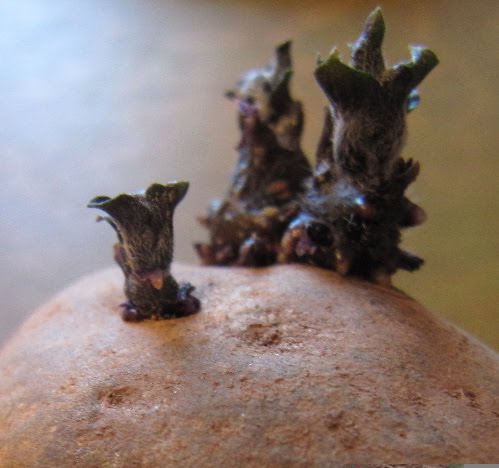
Prepare beds for summer crops - digging in the dark reduces weed seed germination induced by light exposure! Make outside sowings like parsnips and beetroot if soil is warm enough, but avoid ‘pasty’ soil - plant early potatoes if you can protect tops from frost (chit on window sill first - see photo)

Put barley straw in ponds to inhibit algae growth

Lift any remaining leeks and heel them in a shady corner to prevent new growth - leave several for seed saving and their wonderful flower heads

Rake out old thatch from the lawn and if it’s dry and starting to grow cut it - remove any mowings from the lawn early in the season

Leave bulbs alone - dying down naturally is what they like best - if messy foliage offends hide with late-emerging ground cover - snowdrops can now be split and transplanted - leave their dead flower-heads to seed

Ensure ventilation to cloches on sunny days to prevent scorching

Prune roses and hard prune dogwoods and willows grown for their colourful stems - it’s also the last chance to prune apples, pears and soft fruits

Daffodils - dead-head after flowering

Sow broad beans as soon as soil is workable

Deter slugs and snails from susceptible crops with lime, soot or calcified seaweed

Put down tiles and grapefruit halves - in the mornings remove any slug

14 Feb 2011

Seed Swap!

Stroud Valleys Project have just released their latest list of events - you can see them here. Here are two to give you a flavour:

Seed Swap - they are having a seed swap at their Eco Shop, Threadneedle Street, Stroud Saturday 5th March, 2 – 3pm. they write: "Start your gardening year with SVP’s very first seed swap! Bring along any seeds that you have saved from your garden, or any packets of seeds that you have spare, and swap them for some different varieties. A great way to meet other gardeners, share advice and knowledge. Free event, donations appreciated. For more information contact Clare Mahdiyone at SVP, 01453 753358."

Newt Pond survey - I went to this a couple of years ago - see here - well thsi year it is on Friday 29th April, 7.30pm - 9pm & Saturday 30th 7am- 8.30am. They write: "We are monitoring the Great-crested Newt population that lives in this pond near the Stonehouse Court Hotel. It had one of the biggest populations in the SW of Eng- land before a big housing estate was built around it. We’ve been monitoring the pond every year to check if this is having any effect on these rare newts. We will be putting newt-friendly traps into the pond on Friday evening and then emptying them on Saturday morning. No toilets or refreshments. Unsuitable for wheelchairs, prams or people with mobility problems. Wear wellies and outdoor gear, and bring a torch for the evening session. To book your place contact Ivi Svabooza on 01453 753358 or 07876 050878. Cost: £3/adult, £2/child, or £2/adult, £1/child for SVP Friends."

2 Feb 2011

Garden Notes: February

Here is the next set of my Garden notes...plus a look at the moon's influence - for the other sets of notes click 'Label below and scroll down.

February notes

Dig in green manures

Dig in manure on fine days or if soil is frozen store in heaps where needed

Plant onion sets, shallots & Jerusalem artichokes - the latter make a great 2 metre high wind break.


Set up seed potatoes to sprout in trays in a cool, light, frost free place - chitting takes about 6 weeks. Don't forget Stroud Potato Day this Saturday.

Sow early flowers & vegetables in a heated propagator - try 2 or 3 tomato seeds & grow on in the warm then later use side-shoots as cuttings to produce more plants - they’ll take about 2 weeks to root


Weed as necessary to prevent weeds seeding


At the end of the month start sowings under cover or in warmed soil - especially peas (to miss pea moth) & broad beans (to reduce black-fly attack).

Sowing the beans in a square will enable you to inter-plant later with sweet corn


Compost brassicas as soon as harvested to prevent any pests moving to spring planted cabbages.

Start looking for slugs, snails & other vermin like big bud mite infection on blackcurrants (pick off & burn any swollen buds)


Cover soil with polythene & cloches to keep soil dry & warm it up for an early start to the season

Prune late-flowering shrubs like buddleia & cut late-flowering clematis back to 15 centimetres of the ground


Last chance to plant garlic; a clove by each rose will banish greenfly


Moon's influence?

The moons influence on tidal flows and weather patterns is indisputable. Folklore in many ancient societies from the Celts in Britain to the Maories in New Zealand recognised it also influenced plant growth. The Roman historian Pliny (A.D.23) wrote much on the subject, like that grain increases in bulk when the moon was waxing. The birth of modern science led to such beliefs in the moons influence on plants being dismissed - that is until recently.

Studies now confirm that there are statistically significant differences in crop yields according to which days in the lunar cycle the crops are sown; some days being better for root crops rather than say leafy salad vegetables. Interestingly modern studies have also shown that water-absorbtion varies according to different lunar phases, suggesting that some of Plinys work may be valid.

Bio-Dynamic farmers have been practicing lunar planting for years noting higher yields and improved quality. However my fumblings with a lunar calender in the past produced no obvious advantages - but then go and see a real biodynamic garden or farm and the health of crops cannot be denied!

If you are interested, try lunar planting guides by either Nick Kollerstrom or Maria Thun. There are strong opinions about which guides are best. All advise an organic approach, but often contradict when it comes to other recommendations. More research is needed.

3 Jan 2011

Garden Notes: January

Here is the next set of my Garden notes..for the other sets click 'Label below and scroll down.

January Notes

Clean pots & trays in very hot water to reduce diseases

Make cabbage rootfly mats from old carpet, individual cloches from plastic bottles & push old boots & teapots into hedges as nesting places for birds


Use straw to safeguard crops from severe frosts
Keep off the garden when very wet especially on heavy soil - use old planks to pick sprouts & other winter crops

Check cane fruit supports & tree ties & replace dodgy fence posts


Cut down to ground level all autumn raspberry canes


Prune trees & shrubs except during severe frosts, cut out any damaged or diseased branches


Clean out the bottom of hedges & mulch with rotted manure or compost
If soil pests have been a problem fork over the soil

Check stored fruit & vegetables - remove any with signs of decay - pears need ripening in a warm room for 2 to 3 days to develop full flavour, aroma & juiciness


Pot up mint roots to force indoors

Hang bird food near roses so that blue tits devour greenfly as soon as they appear
Make sowing & planting plans for the year - rotating crops outwits pests, reduces disease, maximises soil nutrients, concentrates organic matter where it is needed most & groups crops with similar water needs

This is the time of year for seed catalogues

To an enthusiast choosing which seeds to buy can be harder than double-digging a couch-infested allotment. All those evocative names, enticing descriptions, irresistible photos and oh so much promise. There is no way you can squeeze all those plants into your garden (especially one as small as mine), let alone find time to sow and nurture them. It is impossible. Previous years of passion and over-optimism in seed purchasing are more than evident in the box of old seed packets.

But am I entirely to blame? It’s those over-filled seed packets. Who grows 500 wallflowers, 800 sprouts or 2000 turnips? Thankfully most seeds, if stored dry, dark and at a constant low temperature will last 3 to 5 years, particularly the larger seeds. Some like parsnips only last from one season to the next.


The oldest seeds to germinate were those of the Lotus, carbon-dated as 460 years old and found in peat at the bottom of a Manchurian lake. It unfortunately isn’t true that archaeologists were able to grow beans found in Pharaoh Tombs. If possible choose disease and pest resistant varieties, save your own seed and join a local Seed Savers group.

1 Dec 2010

Garden Notes: December plus snail recipe

Here is the fifth set of my Garden notes..for the other sets click 'Label below and scroll down.

December Notes

Remove any mummified fruit left hanging on trees & check that greasebands are still sticky


Mulch roses after leaf fall & before new growth starts as this prevent reinfection with blackspot

Continue to rake up any leaves you find to make leafmould - there are few better soil conditioners & it is an excellent alternative to peat in potting & sowing composts

It is not too late to plant bare-rooted trees & shrubs. It is better now than in the new year - also if trees or shrubs need moving do it now taking as much soil on the root as possible then prune hard & stake after replanting

Check with a soil testing kit if the soil pH requires dolomite lime - allow rain to take it in but avoid land required for potatoes as lime makes for scabby skins

Remove the old stumps after winter greens are harvested


Rhubarb, chicory & seakale may be forced where heat is available & light excluded


Clear out and scrub down greenhouse inside & out - make any necessary repairs & put up wire for climbing plants next year


Prune apple/pear trees, gooseberries & red/white currants - avoid frosty weather


Bonfire woody waste, potato & tomato haulms & any diseased material in a slow smother fire covered with clods of earth - check for hibernating hedgehogs before lighting it - the ash & burnt soil can be sieved when cool & stored for use in sowing composts next spring (is this the best way to deal with diseased material?)


Choose violas rather than pansies as bumblebees cannot land on the floppy petals of the pansies for nectar

Recipe - not for vegetarians - sent in by a local blog reader

Photo: snail - there was time when I could happily squash these but less and less so. Not sure eating is the answer. What do others suggest?

Gather snails. Keep them in a bucket for 3 to 5 days, feeding them on past-it salad leaves or organic carrot peelings. Their shit goes dark green or bright orange accordingly, i.e. previous (possibly poisonous) gut contents have been replaced.

Clean out the bucket with fresh water if it all gets too foul, and give them fresh leaves.
Starve them for 24 hours. Rinse them, and drop them in a large pan of salted water at a rolling boil (i.e. as hot as possible so they die fast). Boil for at least 10 minutes, rinse under cold water, and use a pin to winkle the little bodies out of the shells. These tiny morsels go well in a tasty sauce. Butter and garlic is traditional, tomato sauces are also good.

Warning: snails are cute. So to make things easier remember the carnage they reeked on your seedlings.

Bon Appetite!

2 Nov 2010

Garden Notes: November

Here is the fourth set of my Garden notes..for the other sets click 'Label below and scroll down.

November notes

Wildlife groups recommend feeding birds through winter & especially spring as gardens are poor substitutes for truly wild habitats - if you feed then feed regularly & provide water in cold spells - try suspending pieces of fat from canes above rose bushes to entice blue tits to eat over-wintering greenfly - but protect cabbage family with netting against the birds - see
here more re fat traps. Gardeners World recommended adding chilli powder to your nuts if squirrels are a problem!

Dig a trench 30 centimetres wide & deep where runner beans are to be grown next year - fill with kitchen waste as it becomes available, covering each addition with soil - in winter this is better than using waste in compost heaps where vermin may be a problem


Collect strawy material to rot down in compost heap for spring use & turn semi-rotten compost heaps

Fork over seed beds on heavy soils - leave for frost to break down over winter

In an unheated greenhouse pot sown carrots & mangetout can be ready for April

Brush snow off trees & shrubs if they are in danger of breaking but otherwise leave plants covered as the snow acts as a protection against severe cold

Winter prune deciduous shrubs removing dead, diseased or overcrowded wood & a few of the old shoots

Remove yellow leaves from brassicas - earth up stalks to protect from frosts & where necessary stake plants

Use a large inflatable ball in the pond to prevent damage to the lining by allowing expansion if iced over - if iced over melt it every few days using boiling water in a dustbin lid to release any build up of harmful gases

Mizuna sown in august should now be ready to pick through until March

Finish harvesting apples & pears before the risk of hard frost or winter gales & lift remaining root vegetables - parsnips benefit from a touch of light frost but should not be left in all winter - examine stored fruit & vegetables regularly & remove any signs of rotting

Last chance to sow broad beans to get an early start next spring & reduce black fly

When frost blackens dahlia foliage lift tubers & store in a frost free place

Clear up debris & make regular slug & snail hunting sorties - try to encourage their natural predators like hedgehogs, frogs, toads, slow-worms and ground beetles

27 Oct 2010

We want your garden!

I've just been putting together some initial publicity for a new project with Transition Stroud. We have a team of active members who are helping plan this event. Here's what I sent to local press:

Photo: mural in Nailsworth Church

Transition Stroud are planning an Edible Open Gardens weekend 9th and 10th July

Following the huge success of the third Eco-Renovation Open Homes weekend in September where people opened their homes to learn more about energy efficiency and renewables, there are plans for an event that seeks to encourage people to grow and learn more about food.

Philip Booth, a Transition Stroud member said: "We are after veg and fruit gardens, allotments, herb and kitchen gardens, chicken keepers and more for people to come and see. We want to celebrate some of the wonderfully productive gardens and local food growing projects in the Stroud Valleys. Local food accounts for only 1.5% of national food consumption. Our food system is staggeringly inefficient and heavily dependent upon oil, at a time when the production of energy from fossil fuels is on the decline. Our dependence on imports is damaging for national food security, harmful to the environment and is simply unsustainable (i). With this Edible Open Gardens project we hope to all learn but also inspire more local food production at a lower environmental cost than the supermarkets."

Transition Stroud is a group working on the transition to a locally based low carbon. 20 gardens are already signed up. If anyone is interested in offering their garden for part of the weekend in July please contact Helen Pitel on 762957 or Philip Booth on email at: philip.booth2(at)virgin.net

Notes:

(i) Food Availability in the Stroud District, December 2008, written by Fi Macmillan and Dave Cockcroft of Transition Stroud. Download here.

8 Oct 2010

Garden Notes: October

Here is the third set of my Garden notes..for the other sets click 'Label below and scroll down.

October Notes

Pot up a few roots of mint to grow inside for winter use

Apply grease bands to apple & pear trees and rose bushes to control scab and blackspot

Cut summer wildflower meadows - remove hay - cut lawns for the last time - service mower

Divide and replant rhubarb

Cloche autumn-fruiting strawberries to prolong harvesting - when finished remove old leaves, weed and take mulch away

Sweep up fallen leaves and put them into a wire netting container to make leafmould - treat beds to a good dressing of well-rotted leafmould

Cut down Jerusalem artichokes, earth up leeks; clear away pea sticks

Sow sweet peas in old toilet rolls or deep pots in a cold frame - soak seed overnight before planting

Leave flower heads to supply seed for birds and places for ladybirds and other critters to hibernate - save seed from those that interest you for next year

Plant spring cabbage, autumn onion sets and garlic, sow broad beans, peas and a final sowing of winter-hardy lettuce and sow green manures like grazing rye or field beans

Prolong greenhouse growth by extra insulation with bubble polythene sheeting

Prune blackcurrant bushes anytime after leaf fall - use prunings for hardwood cuttings - other possible hardwood cuttings include dogwoods, flowering currants, mock orange; willows

Bring into the greenhouse potted figs and bays that have stood out for the summer

Harvest pumpkins as late as possible so that they ripen well - but before the first frost

Plant garlic cloves from mid-October - choose large, healthy bulbs and plant in deeply dug, composted soil

24 Sept 2010

Leek moth problem again in Ruscombe

Last year we lost many leeks in our garden due to the leek moth. I didn't know about the problem and none of my gardening books had details - indeed there is not much info as this is a fairly new problem.

Well the moth is back this year - a neighbouring allotment plot holder, Chris Tracey, has just lost all her leeks - she has kindly let me post these photos so others might be able to identify the problem. I also hear that the SCA farm at Brookthorpe also has the problem.

Apparently even the UK Moths website says this is not a pest in the UK as its status is “local or scarce” but they also say it is a pest in Europe. Also that the known lifecycle starts in October and lasts through the winter – we now know that it starts earlier than this. Another site says it was first found in the West Midlands in 2003.

The leek moth used to be confined to the south coast but it is obviously spreading quickly. What a shame - leeks where one of those veg that I have grown reliably for many years with no problems at all. More worrying is that I read that it can also spread to other alliums like garlic and chives. I would welcome

What happens is that said moth lays its eggs on the leek plants, the caterpillars hatch and tunnel their way through each leek with the aim of pupating within the leek or just outside in the roots of the plant. Then the cycle begins all over again.

I have found a picture of the moth here but we are unlikely to see the culprit as of course it will be nocturnal.

On the Saunders Allotment website, it says that “realistically, if you live in an area where leek moth is prevalent the only way forward is to provide some form of physical barrier to prevent the female moth reaching the crop”. Once the maggots turn into moths, in the autumn, they overwinter, and then next year, there they are again! So the only thing for it is fleece apparently or even better Enviromesh. No pesticide exists, but apparently traps are now available - see here. I wonder if chickens might help to get rid of the overwintering critters?