31 Oct 2007

Party funding talks collapse

The collapse of the cross-party talks on party funding chaired by Sir Hayden Phillips is deeply disappointing and sends out a terrible message to the electorate.

This isn't going to stop politicians from increasing state funding - in the last year alone MPs voted for themselves a £10,000 annual Communications Allowance. Without an agreement this will only get worse and increase the influence on individual millionaires while local politics will continue to decline and cynicism about politicians will fester.

The Tories objected to Sir Hayden’s draft proposals on trade unions yet the rules clearly state that donations from trade unions will only be exempt from the cap if they can be clearly linked to an individual and subject to an audit trail. The Conservative objection appears to rest on the idea that trade unionists should be capped more heavily than rich businessmen, which is manifestly not equitable.

I do not agree with all the proposals - indeed they go nowhere near far enough - but at least Sir Hayden’s draft proposals are an attempt to get to grips with this issue.

As Director of Unlock Democracy Peter Facey said: "By pulling out of these talks following the collapse of the police investigation into the alleged abuse of the honours system earlier this year, the message of the major parties to the public is clear: it is business as usual. This can only lead to greater cynicism and alienation from the political system. So much for Cameron’s and Brown’s competing claims to embody ‘new politics’. It is time for Parliament to try and get them out of this mess."

Cabinet sings praises of brook action group

Stroud District Councils' Cabinet have approved the Ruscombe Brook Action Group (RBAG) memo of cooperation (see previous posts). The meeting on Monday afternoon was an additional Cabinet meeting to look at flooding issues - for details of some of the points see last blog entry - or watch the webcast of the meeting.

Photo: Cabinet papers

It was good to hear the Cabinet recognise the good work of RBAG - see Special Meeting of Cabinet 29th Oct here:
http://www.strouddc.ukcouncil.net/site/index.php#pp10946

Thanks indeed to all who have helped - a well deserved recognition from the Council.

The Cabinet also covered other flooding issues and are giving some of the central government money to help prevent future problems in Slad brook and other water courses. Tackling prevention makes much more sense than some councils that are using the money to re-wallpaper houses. They have also confirmed a Policy Panel on Sustainable Urban Drainage systems - something I have been requesting for a while.

All these are excellent steps towards developing an holistic approach to managing water in the District - something much needed as Cllr Lunnon noted at the Cabinet meeting.

Other brook and water-related news:

The Lawns -
I went with another RBAG member on Monday night to Cainscross Parish Council meeting to hear Stroud Valleys Project share more re the Lawns project - more of that at next RBAG meeting - they have produced plans for management of the site looking at key issues like biodiversity and use of site. I was able to share some of the results from Ismailas project on the brook.

Next RBAG meeting - 7.30 Tues 4th Dec - contact me for venue and further information. Join us!

Randwick sewage incident - Severn Trent will be renewing the manhole cover on the Randwick tributary this Thursday (see earlier blog re problem). They have also been measuring flos with a flow meter at that site.

Cotswold Canals Brimscombe Area Action Plan - The Area Action Plan is now open for comments. For more details click here.

28 Oct 2007

Brook update: MSc project, plan and Cabinet meeting

Last week we had a Ruscombe Brook Action Group meeting - minutes will be out soon but wanted to give a brief summary...

Photo: Aerial view of brook

MSc report and plan for brook

The highlight was hearing from Ismaila - the Masters student from Glos University who has been researching the brook - I can't go into details here as his project was huge but he gave us a brief verbal summary (written available soon) - it showed that between June and September this year water quality remained fairly good although deteriorated down the length of the brook - there were no sewage incidents during that time - looking at the silt along the brook - again this got worse as he got down the brook although the worst point was at Puckshole with lots of nasty faecal contamination.

His recommendations included more sampling and SUDs - Julian Jones from Water 21 will now be working on these plans and suggestions to present a first draft plan of action for the brook - he hopes to have that at our next meeting (see date below). It is brilliant to have such great support for the project.

At the end of the meeting we presented Ismaila with a framed photo of the brook and thanked him enormously for all his work.

Update on work along the brook

We have only had one serious incident in recent months where sewage got into the Randwick tributary (see previous blogs). Severn Trent have installed a flow meter in the sewer to see if they can identify problems at that point.

Severn Trent Water have also been cutting roots in sewer pipes that run near the brook, and other works - these do seem to have significantly improved matters. There is also now a plan to reline some sections of sewers where roots have re-grown- indeed they have been approaching householders to get permission to go on their land.

Leaflet being delivered

The Severn Trent funded leaflet about the brook is now being delivered - more of that later - but huge thanks to all who are helping with that.

Memo of Cooperation and Cabinet meeting

We now have nearly all relevant bodies signed up to a memorandum of cooperation to look at sustainable ways of reducing flooding at sites like Puckshole and improving water quality and biodiversity. Stroud District Council's Cabinet are due to consider it tomorrow (Monday) - see below - they are also looking at various other issues related to flooding like the Slad Brook Action Group - clearly with properties and businesses flooded they need to be a priority for funds - plus tackling Stratford Park where 600 tonnes of rubble and silt was brought down the brook there by the floods.

Another idea that gets support from me is funding the setting up of a voluntary watercourse wardens scheme - again more of that in future posts.

Cabinet recommends to Council that: (i) The £60,000 Flood Relief Grant be allocated up to the levels indicated:- (a) £9,000 (revenue) be used to remove rubble and associated debris from the Painswick Stream.
(b) £25,000 (capital) be used to fund an inspection of culverts and a hydraulic study of the Painswick Stream so as to identify a prioritised programme of necessary repairs and improvements which will be used to advise riparian owners of their responsibilities.
(c) £6,000 (revenue) be set aside to assist the Slad Brook Action Group (SBAG) to accomplish small scale clearance works.
(d) £15,000 (capital and revenue) be set aside to assist SBAG in working towards establishing an attenuation scheme on the Slad Brook to alleviate the risk of future flooding events.
(e) £5,000 (revenue) be used to promote the concept of watercourse wardens with Parish Councils and to provide necessary training and guidance.

(ii) The action plan in appendix B to report DS-137-10-2007 be approved.

(iii) Council agrees to be a signatory to the Ruscombe Brook Group Memorandum of Understanding as set out in appendix C to report DS-137-10-2007.


Next RBAG meeting

Do join us at our next meeting 7.30 Tues 4th Dec - contact me for venue and further information. Join us!

27 Oct 2007

Dismay at British government over Burma

I am dismayed at the lack of action on Burma from the Department for International Development (DFID) - the British government has been better than many at calling for international action yet DFID is failing us. MPs had demanded a big increase in aid to Burma, funding for cross-border aid, and funding for projects promoting human rights and democracy in Burma yet DFID has taken no action in any of these areas. Take action at: http://www.burmacampaign.org.uk/dfid_action.html
(See previous posts re Burma by clicking on Label below)

26 Oct 2007

Undemocratic Regional Assembly for the chop - but what in it's place?

Some interesting correspondence regarding the membership of the South West Regional Assembly below - of course this Assembly is set to be abolished very soon - see consultation details below - but thought worth including here how this undemocratic Assembly works - basically excluding large sections of voters views - perhaps no wonder they can come up with a Regional Spatial Strategy that increases emissions over next 20 years instead of cutting them.

Photo: Randwick Woods

Anyway here first is how Assembly Members are currently identified:

Seventy percent of the Membership is drawn from the region's 51 Local Authorities. The remaining thirty percent of the Membership is drawn from sectors across the region. These Members are known as the Social, Economic and Environmental Partners (SEEPs). In addition, there are two National Park Members and two representatives of Local Councils (Parishes). Local Authority Members are identified in two ways.

First, each Local Authority nominates one Councillor to represent the Authority on the Assembly. These 51 Members are then 'topped up' from County and Unitary Authorities with additional nominations to ensure the Members from Local Authorities reflect the political makeup of the South West as a whole. These additional Local Authority Councillors are nominated by political groups in the South West in accordance with a formula agreed nationally by the Local Government Association and the political parties.

To answer your question, political parties are represented on the Assembly by Local Authority Members, and therefore, a Green Party Councillor would have to be nominated by the Local Authority on which they sit to serve as an Assembly Member.
In addition to the Local Authority members, there are currently 36 Social, Economic and Environmental Partners (SEEPs) amounting to 30% of the total Membership of the Regional Assembly. They represent a number of sectoral interests of importance across the South West, which includes the Business and Economic Sector, Agriculture, Health, Environment, Trade Unions, Learning, Skills and Business, Voluntary and Community, Equalities, Youth, Faith Communities, Public Transport Users and Housing.

All aspects of SEEPs Membership is reviewed every four years. SEEPs are nominated by regional organisations from the sectors listed above. In order to qualify as a nominating body for the Assembly, an organisation must demonstrate that it has a regional remit, represents interests in economic, social and/or environmental development, and has clear processes in place for selecting its representatives to the Assembly. The term of any SEEP appointment is set by the nominating body and is usually between two and four years, though some require annual elections. Like all other Assembly Members, the SEEPs sign up to the Code of Conduct for Members and complete an annual register of interests. More information about the Regional Assembly and Assembly Members can be found on our website www.southwest-ra.gov.uk


Another question was posed by a Green:

"These 51 Members are then 'topped up' from County and Unitary Authorities with additional nominations to ensure the Members from Local Authorities reflect the political makeup of the South West as a whole". I take it that by "political make-up" you mean the political constitution of the various Local Authorities. Democracy is that system of government where ultimate power resides in the will of the people.

The people express their will in a vote. The electoral system then interprets that vote in a variety of ways. In the UK we have a particular electoral system called First Past the Post (FPTP) which results in a variance between the proportional vote expressed by the people and the resulting representation of elected members on the Local Authorities.
In "topping up" to reflect the "political makeup" of the South West as a whole, the SWRHA is perpetuating the distortions arising from FPTP. It would be more democratic if the political allocation of the SWRHA were to reflect the votes cast in the South West, rather than the seats allocated.


Here was a response:

As officers, it is not for us to agree or disagree. The South West Chamber and the South West Planning Conference agreed the constitution for the Assembly when the two groups came together to form the Assembly in July 2000. The constitution under which we work includes details of how the Membership should be identified based on the Rallings and Thrasher model, which is also the method the National LGA employ. If you have any further questions, you may find the answers by looking at our Frequently Asked Questions: http://www.southwest-ra.gov.uk/nqcontent.cfm?a_id=61&tt=swra

And some more Green comment:

Thank you for the link to the FAQs. I read: "...the share of seats each party has in a local authority is calculated. For example, if in a 40 seat council, party A has 12 seats, party B has 15, and party C 13, the percentages would be 30%, 37.5%, and 32.5%. Each party is then said to represent that proportion of the authority's electorate, expressed in raw figures." This means that instead of taking the actual vote cast, which would respect the principle of democracy, the method used includes the distortion applied by the electoral system, which includes the notorious effects of the FPTP system.

Well fear not - the Government announced in July that Regional Assemblies will not exist in their current form after 2010 - therefore questions on the future of regional governance in the region, should be addressed to the consultation when it is launched by Government http://www.southwest-ra.gov.uk/nqcontent.cfm?a_id=3322

I have to say the proposal for Regional Development Agencies is equally worrying - again seem to be totally undemocratic.

25 Oct 2007

Cashes Green Hospital site latest

This comment piece appeared in The Guardian yesterday about the Cashes Green Hospital site (see also previous blog entries using search facility on this site - 13th June last main entry) - I've also added a bit more after this article...

Photo: Cashes Green Hospital main building


Opinion: Does Whitehall really trust us on housing?

By Peter Hetherington - Wednesday October 24, 2007. See article in The Guardian here

No one can doubt the commitment of Hazel Blears in championing the cause of "community empowerment" - namely giving people the tools and confidence to run neighbourhoods free of the dead hand of town hall and Whitehall. Launching an action plan last weekend, the local government and communities secretary invoked her record in Salford, where she is MP and resident: "All my life I've been a firm believer in local activism ... my whole approach, fashioned on the streets and estates of Salford, is anchored in localism and devolution."

The plan contained 23 areas for action, including one to support a cooperative concept of land ownership, apparently dear to the heart of Blears who wants communities, rather than state or local government institutions, to control neighbourhood assets wherever possible.

Community land trusts, an innovative concept yet to take off in England - although self-governing Scotland has set the pace with far-reaching land-reform legislation - should fit the bill. The trusts hold land in perpetuity after it has been transferred from a public body or an altruistic landowner. One effect is to rule out speculation and ensure that the community captures an increase in value - a handy asset to borrow against for further local benefit - once planning permission is granted for housing and other neighbourhood facilities.

But there are already problems, leading some to question the will of Whitehall to deliver. In the one area regarded as a national pilot for land trusts, activists are discovering that reality on the ground does not match ministerial rhetoric.

The Gloucestershire town of Stroud might appear an unlikely starting point. But outward signs of prosperity obscure a deepening housing crisis for locals priced out of the market by second home owners.

At stake is a 4.5-hectare (11-acre) former hospital site, known as Cashes Green, on which a local community land trust wants to build 77 houses; 50 affordable units cross-subsidised by the 27 for sale. In June, the government's regeneration agency, English Partnerships (EP), under the wing of Blears' department - which acquired a string of former NHS sites for housing - announced it had agreed to hand over Cashes Green to the community land trust, subject to ministerial approval. In a statement, the agency stressed its support for innovative methods of delivering homes for renting and buying.

But when the deal reached Whitehall, matters stalled. Some believe EP was asked to think again. Now, it seems, a revised plan will propose that between a third and half of the site goes for mainly social housing run mutually. Most of the rest will go for private development. This will effectively end the mutual ideal, scuppering the plan. It seems that, in the culture of short-term Treasury accounting, Cashes Green is less "valuable" as a community resource; ie, more private houses will yield a better return. The matter has gone back to EP for further consideration. The community trust, Gloucestershire Land for People, is perplexed. Stroud's Labour MP, David Drew, is " worse than annoyed ... we're [now] struggling to get it off the ground."

No matter that those ministers are committed to increasing England's level of social housebuilding - almost doubling levels to 50,000 annually after three years. "If the government wants to increase supply to these levels, it's crucial to use public land," says one official close to negotiations. "It needs to weigh the long-term gains in providing decent housing against the short-term gains of increasing capital receipts."

What does this teach us about community empowerment? Perhaps, while welcoming the worthiness of Blears' commitment, to reserve judgment on the implementation of detailed plans.

In Scotland apparently 'landed power' did all it could to block land reform from taking off. Fortunately under Donald Dewar politicians took the side of the people and so the Land Reform (Scotland) Act 2003 was pushed through as flagship legislation for the new Scottish Parliament. This legislation provided a high level of political impact for very little cost to the public purse - Scotland has moved from a situation where there was very little Scottish land in community ownership to one where there is now 367,000 acres under communities ie 2% of the Scottish land mass!

This is how it has been described by Professor Alastair McIntosh: "The basic driving mechanism is simple. The average cost of a rural hosing plot in Scotland is £50k, which requires earnings of about £8k after tax and NI to cover the mortgage for the land value portion of value alone. But agricultural land sells for only £3k / acre, and you can comfortably put 7 plots on an acre. The current status quo is stitched up by land ownership and a planning system that has failed to take on the evolution of low-impact ecological architecture and the need to rekindle both a rural and urban human ecology. If communities are given back the land, huge economic benefit, and more, is set loose. On the Isle of Gigha, for example, only one new house had been built in the previous 30 years of landlordism. Since the buyout, 30 houses have started going up, half of them in social ownership, and life has returned to a dying community."

England has not yet woken up to what land reform really means as the asset base for community empowerment. Alistair McIntosh goes on: "It is about much more than agriculture, or even socially affordable housing and entrepreneurial opportunity. It is about rekindling applied values in what I call the Cycle of Belonging. Here, 1) a sense of place generates, 2) a sense of identity, that carries with it, 3) a sense of values, which in turn nourishes, 4) the sense of responsibility necessary to cultivate social justice and environmental sustainability in strengthening community of place. Too often this agenda in Britain and a wider Europe has been grasped by the xenophobic political right and applied in ways that would seek to build identity through exclusion – especially minority ethnic groups. In Scotland we are very clear that identity linked to place must be inclusive: the way that I put it is:“a person belongs inasmuch as they are willing to cherish and be cherished by a peoples and their place.”"

Let us hope Hazel Blears wakes up to the potential here on our doorstep.

Andy Wightman's website is good with good links at:
http://www.andywightman.com/
See also:
http://www.communitylandtrust.org.uk/

24 Oct 2007

Proposed incinerator near Stonehouse?

RubbishOn Monday one of the meetings I attended was of Green councillors looking at waste in the County - could write for pages on that - indeed many items on this blog - but a crucial issue was the concern that the County maybe going back on it's promise of no incinerator...

Copyrighted photo reprinted here with permission of Seattle-based photographer Chris Jordan. See more photos.

I hope this is not true as I am sure there will be mass protest if such a proposal is serious - below is my letter yesterday to the Cabinet member responsible at the County Council - I await with interest - meanwhile Martin Whiteside has sent a letter to local press putting the case against a monster incinerator. The Green party email lists have also been alive with debate - more of that perhaps in another blog and below after this letter....

I note that you are looking at all the options regarding waste for the County - I also note that the Government has not made it easy for Councils - you'll no doubt be aware that Ken Livingstone recently weighed into the debate with a strong case that Labour Ministers are colluding with incinerator operators keen to win lucrative contracts.

I write as I have grave concerns about Glos County Council noises in the press recently about the possibility of Gloucestershire having an incinerator. You will know that many are wholly opposed to this unnecessary and damaging move. Indeed I had thought the idea well and truly buried as I understood Conservatives in the County had promised no incinerator?

It is the view of some waste experts that fines are being used to 'terrify' councillors and others into making a decision for incineration. Correct me if I am wrong but I understand that to meet the Landfill allowance trading scheme (LATS) we need 65% recycling/ composting/ recovery. That means we only need a tiny recovery if you get 50% composting & recycling by 2020. That should be possible - and provide more jobs.

The LATS system has been going for just over 2 years and I understand the report on the 2nd year is due any day. It is only the biodegradable content that counts ie landfill 100 tonnes of mixed household waste and you need 68 tonnes of LATS. If you could take out the 68% that was biodegradable and landfill the 32 tonnes remaining you would need zero LATS. The way to get to LATS is to aim for zero residual waste. You then need a far smaller treatment plant and you need it at a lot later date. It would seem most councils will only need to treat a around 15% of the waste if they meet the governments 50% recycling targets unless they have a large population growth.

Clearly there is an issue around what percentage of waste would be incinerated in any incinerator. However I strongly consider we can do this without resorting to incineration - reducing, recycling and home composting - with a truly decentralised system for dealing with the remainder cleanly and efficiently - as I am sure you are aware the technology is now available for smaller local units such as ‘gas pyrolisis’.

Incinerators, as I am sure you also know, create legally binding disincentives to improving recycling by tying the council into a contract to supply waste for incineration, they produce extra traffic and noise, have 5 times fewer jobs than recycling, have health risks, they destroy valuable resources, produce toxic ash which still has to be land filled and exacerbate climate change because when materials are burned, more fossil fuel energy is used to replace the products through mining, manufacturing, and transportation.

I hope very much that you will be able to choose the sustainable solutions that will bring the most benefits to Gloucestershire and future generations. I would be interested to hear more on your thoughts.

Best wishes, Philip

Cllr. Philip Booth

Most of the latest strategies re waste still are based on waste growth to justify building big burners. Leicestershire for example expects waste to grow 40% over the next 32 years but it
is in fact down 4.5% over the last 2 years. The massive waste growth is over here in Gloucestershire too... Practical maximum levels of recycling may be 70-80% today but the waste facilities have very long contracts. Products will be redesigned if they cannot be recycled as we run out of resources. We need residual waste treatment to sort the residual into fractions which are then treated differently. We need to render the biodegradable fraction inert. Aerobics digestion may well be the best method at the moment. We also needs plant(s) to be adaptable to cope with falling residual waste tonnages. Short contacts are vital to prevent the residual waste treatment forcing the long term production of residual waste.

In 30 years time you should look at 97.5% recycling and 2.5% residual. That means the average material goes though the consumer 40 times (i,e, 1/40th is lost in each pass). The very best extreme recyclers get to that level today.

Want to write more but a Ruscombe Brook Action Group meeting very soon so must gather bits together....

Ground Source heat pump in District

I've been asked a couple if times about these pumps - basically Ground Source heat pumps are a tried and tested Scandinavian technology, but not yet in widespread use in the UK. They work by extracting heat from the ground, via a borehole, and using this to heat the property. This reduces running costs and CO2 emissions.

Photo: Ruscombe village

A Housing association in Cornwall has retro fitted them to a handful of dwellings. Stroud District Council are part of an energy forum of local social housing landlords, and none of them have yet installed heat pumps in their social housing. The problem with energy saving measures in rented homes is that they are high capital cost to the landlord but they do not see payback as the tenants gain the benefits of reduced running costs.

Grant funding has now been available from Powergen for a minimum of six adjacent properties. This means that the cost to SDC of installing a heat pump becomes comparable to that of installing oil fired central heating, and hence affordable to SDC. They have picked properties in Coaley as they are away from the gas main (SDCs first choice heating fuel); some have solid fuel heating that was approaching the end of its life, and some night storage heating.

SDC have 7 properties on the scheme. Each will have a new central heating system, served by the heat pump, which will also provide hot water. Their homes will also have an insulation upgrade, which will include checking cavity wall insulation, improving loft insulation, replacing ill fitting external doors and checking windows for draught proofing. Part of the project will be to review the running costs and performance over the course of a year to see what might be possible elsewhere.

Camp Hope success

It seems clear from the people who joined the camp that it was a big success in raising awareness. Some 100 people on the Saturday and 30 camping the night - TV crews and journalists - I know Greens who went are writing letters to the local press as a follow up.

Photos: The Citizen had a good article with photos of Gloucester and Cheltenham Green party members supporting the demo - below is the leaflet handed out to the airport.

Kevin Lister, one of the key organisers of the Camp, is to be applauded for his energy and passion at getting this issue onto the agenda - see his letter here to the airport management praising them for their approach to the Camp but also strongly disagreeing with them about their conclusions. It is at least welcomed that the Airport has reversed their opinion on climate change and now accept that it is a real concern.

It was also interesting to hear about the anger of some locals to the airport - as Kevin notes in his letter one Staverton resident told about how every second house in his street seems to have a cancer victim - even if this is an exaggeration it is deeply worrying - I had not been aware of this additional issue - but apparently this would concur with research which shows cancer clusters around airports - see http://www.areco.org/ExpAir.pdf

While cancer is another aspect around the airport growth, the issue around climate change remains the most important - unless we can act on this then we are in serious trouble as this blog keeps saying!

I wrote this week another letter on aviation - this time to the Local Government Association weekly mag to all councillors - there had been yet another article singing the praises of expanding regional airports - see my letter here.

Liberal-Tory proposal to scupper efforts to tackle climate change

Having had a go at Labour in my last post I don't want people to think the other lot are all wonderful - here is an exposure of Liberal and Tory MEPs -the European Parliament is voting today on a report outlining how it believes emissions reductions from cars should be achieved and what limit values should be proposed, with a view to influencing forthcoming legislation.

Copyrighted photo reprinted here with permission of Seattle-based photographer Chris Jordan. See more photos.

UK Tory and Liberal MEPs have proposed an amendment to set weaker emissions limits for carmakers and to postpone the introduction of these limit values by a further three years, despite the urgent need for action. Basically they want to allow carmakers to produce dirtier cars and to delay the introduction of urgently needed emissions limits - this will scupper EU efforts to combat climate change.

An independent study, presented by the Greens/EFA group in the European Parliament last week, showed that only by introducing strict limit values for passenger cars as soon as possible will the sector be able to contribute sufficiently to enable the EU to meet an overall CO2 reduction target of 20% by 2020. The study showed that an average CO2 emissions limit value of 120 g/km must be introduced by 2012 if cars are to contribute their share towards the EU's overall emissions reductions and that stricter limit values for 2020 will also be necessary. In order to meet the 30% reduction, which scientists say is absolutely vital from industrialised countries to tackle climate change, significant measures not only to reduce vehicles emissions but also to reduce the amount of car travel are necessary.

Caroline Lucas MEP Comments: "The EU must make these deep cuts in its CO2 emissions if we are to try and keep climate change in check. Letting those sectors that are the worst performers off the hook, by allowing them to delay urgently needed emissions cuts, would make a mockery of the EU's climate strategy. The European Parliament has consistently called for strong measures to tackle climate change and we hope they will continue to do so and reject the Tory-Liberal proposal."

Labour failure on climate change and peak oil

The Guardian reports that leaked documents suggest that Ministers are planning a U-turn on Britain's pledges to combat climate change that "effectively abolishes" its targets to rapidly expand the use of renewable energy sources such as wind and solar power.

This is monstrous - see a Green party press release that I sent out earlier today. I have highlighted this previously and can hardly believe Labour are still pushing this - all their talk of action on climate change amounts to spin - emissions have risen under Labour when we need a 90% cut. A local Whiteshill resident also pointed me today to the Oil Drum where there are some more comments re Labours actions on this.

Meanwhile
a new report notes world oil production is to 'decline at a rate of several percent a year' and forecasts 'disturbing scenes of mass unrest' - see Energy Watch Group release yesterday they say that last year we have already reached peak oil - the point when oil extraction reaches its highest point and then starts to decline - see Stroud Green news release here. Again Labour are failing to act on this crucial issue.

Culling badgers 'counter-productive'

The Green Party has criticised the the government's Chief Scientific Advisor's recommendation that culls of badgers should be carried out to control the TB epidemic in cattle. This is deeply disappointing that they could ignore the science. See our local news release today here.

This is an issue I have followed over the last couple of years - Greens in Stroud mounted a campaign last year - that's me in the badger outfit in the photo - I've spoken with numerous people including several local farmers both supportive of cull and against and with local vets who support the cull. See Len Ballingers story here - he was a local farmer whose cattle were the first in Britain to be linked to the theory that bovine tuberculosis comes from badgers and he has since rubbished the connection – and declared his land a "no-kill zone".

The story is not straight forward but despite seeking the evidence to see if a cull was justified I have failed to find any that makes a cull the answer - the stuff is just not there - as Roy Hattersley says today in The Guardian 'Science backs the badgers' - I am sure this will lead to more local actions by the Stop War on Badgers group - I have joined there meetings several times in the past - their website is well worth a look to see a slightly different view from the Badger Trusts - basically we urgently need research that is broader than the past trial and looks at wider issues - I'm no scientist but my gut feeling is that it is our industrialised farming that is at fault - it is crazy that dairy farmers need to increase yields from cows by some 3% a year and many now keep cows inside all year around - see a letter I wrote last year here.

23 Oct 2007

Latest on Puckshole

Work has at last begun on Puckshole - the workers are saying it will take 2 weeks before the road is reopened.

Top 20 Green blogs

This year Jim Jay selected his top 20 Green blogs in order below - sadly Ruscombe Green didn't make it despite monthly viewing figures of over 1000 people (470 plus of those are returning for more looks) and average stay times of 8 minutes. As he notes himself it is difficult to compare political blogs that cover local council issues with ones about economics or living a green life or whatever - the competition is stiff - the top 20 is below and Jim is now seeking a peoples vote - go here to vote - our very own Stroud-based Molly Scott Catos blog 'Gaian Economics' is at number 7 - see her comment about the voting.

Photo: Prof Rupert Reed - a Norwich councillor and leading Euro candidate has just started blogging- see here

Here is the 2007 top twenty submitted to Iain Dale's Guide to Political Blogging by Jim Jay:
  1. Alice in blogland
  2. Sian Berry
  3. Tom Chance
  4. Transition culture
  5. Derek Wall
  6. Jenny Jones
  7. Gaian Economics
  8. Know your place
  9. Peter Tatchell
  10. The Ecologist
  11. Green Girls Global
  12. Earthquake Cove
  13. Philobiblon
  14. The Void
  15. Green Ladywell
  16. Barkingside 21
  17. Green Jelly Bean
  18. Coventry Green Party
  19. Conserve England
  20. Greenman's Occasional Organ

21 Oct 2007

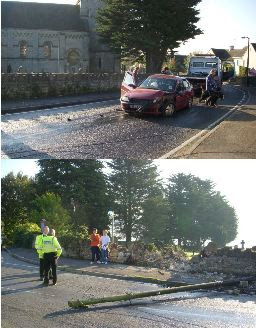
Crash at Whiteshill turns Ruscombe Road into A46

Yesterday I waited for the 10.22 Gloucester bus at the Woodcutters, Whiteshill - there did seem to be very little traffic coming up the hill - a police car eventually stopped and informed us there had been an accident and the road was closed - it was hoped it would open in 2 hours or so - well back again the bus still wasn't running.

Photos of crash courtesy of Parish Councillor Gerri Kimber who lives near the site

I don't know what time the car was eventually cleared - and hope no one was hurt - the accident did make Whiteshill wonderfully quiet but with Puckshole and the A46 still closed it turned the Ruscombe Road into the A46 - cars streaming down despite reroutes via Stonehouse. Ironically the Parish had received an email yesterday from the Cabinet member at Glos County Council noting it seemed that the current measures re the traffic were working in Whiteshill.

It is true much has been done (see label below for more re A46) - I don't know how this accident happened but it is clear that the traffic is still too fast and too much. We need 20 mph and traffic calming measures - and will continue to push to get our village back.

Anyhow by the afternoon I wasn't feeling so great anyway so my trip to join Camp Hope (see previous blog) had to be cancelled - a great disappointment - I had armfuls of sandwiches and more to share there - apparently it was a wonderful atmosphere on Saturday - more of that in a later blog - today am feeling better but have a busy week and need a quiet day - as regular blog readers will know my health has not always been as good as I would want - a great pity as I really wanted to be at Camp Hope - it is infact 5 years on Wednesday when I wrote my first press release re Staverton. Those of us writing in protest then seemed lone voices - it is great to see the mushrooming of support.

19 Oct 2007

Camp Hope tomorrow

The camp will be directly opposite the entrance to the airport on Bramfurlong Lane - see map below - see you there.

See background info here and by clicking on 'Airport' label below...also the residents campaign website is now looking great - see it here - it also has various ways to take action. By Bus - The Number 94 bus service between Gloucester and Cheltenham, stops 900m from the Airport entrance. Ask the driver for ‘The Plough’ or ‘Airport’ stop and follow the signs from the road junction. The bus operates in both directions, every 10 minutes.

PhotoStroud: a monster success

Monday evening I went to the opening of the PhotoStroud Festival of Photography 2007 exhibition at the Museum - this is just a couple of exhibitions in a whole host of venues.

Photo: Main exhibition room at Museum

'Facing Youth' at the Museum in the Park features photos by 13 to 17 year olds who attended workshops by Alexander Caminada - there are also some of his photos there - what a great project - we need more of these across the District!!

Photo: Two of Alex Caminada's shortlisted photos - of Puckshole resident and fishmonger David Felce and sculpter Simon Packard whose children go to Randwick School. These are the photos causing controvesy as they have been banned from the final competition due to the frames being while - Alex was offered black ones but considered they would damage the integrity of the photos - he felt guidelines were not clear enough.

The other main exhibition at the Museum is the Stroud District Council arts award shortlist - the public can vote on their favorites and that will form 25% of the final judging.

Photo: Cyril Laffort: loved his photos

This Festival is another example of Stroud at it's best - a large number of photographers are exhibiting across the area - the Sub Rooms, the space, Ruskin Mill, Stroud College, Kanes Records, Tinto restaurant (with Bread Street photographer Mike Gallagher), Kingshill House, Woodruffs, Mills cafe, the Apollo cinema, Star Anise, Prema and many more venues. I've since Monday managed to catch a few others - it is worth the effort before they end on 27th October.

Photos: Allotments

A huge thank you to all who helped organise this event - a wonderful enriching experience. I totally agree with the letter in this weeks SNJ thanking especially Fred Chance and Carlos Ordonez.

Civil Parking enforcement and more scrutiny

I've not slipped off and deserted this blog - it's been a busy week with various bits and pieces - so rather than go into lots of details I'll do a brief summary - do please email or call me if you want further info.....in terms of Council business the week started with...

Photo: Police have parking enforcement responsibilities until 5th Nov - here they are earlier this week in action opposite Blockbusters

Parking briefing

On Monday for all councillors - Parish and District - but being during 'normal' working hours meant only a few of us there. The District takes over responsibility for civil parking enforcement from 5th November - basically this is good news re more local control but it is yet another squeeze on local resources - no extra money to set up ie £1.2 million - when the parking ticket fines come in they will help running costs - when we break even then we can spend money on related community benefits - some say we never will break even - there is no contribution from central government and it seems the police who will have a much reduced work load in this area also wont make a contribution or see their monies drop.

District councils will enforce on-street parking in most of Gloucestershire from 5th November. Five district councils will be taking over from the police traffic wardens in a partnership project led by Gloucestershire County Council, the sixth - the Forest of Dean - is likely to follow next May.

Introducing Civil Parking Enforcement will hopefully help the District to manage congestion, improve turnover of parking spaces outside shops, prevent abuse of disabled bays, and release police resources to tackle crime and disorder. So from 5th November Stroud District Council will be responsible for both on and off-street parking enforcement, with a team of parking attendants on patrol. While Cotswold District Council will be carrying out back office functions including payments and penalty charge notice processing on behalf of Stroud District Council. Plus the County Council will deal with parking strategy and new parking schemes. The police will still be responsible for enforcing cases of 'obstruction', for example cars blocking a private driveway or a road without road markings.

There is lots more info about how this will work on the District website - with more info coming soon - Winchester has seen a 50% reduction in double yellow parking andcar park use is up 8.6%. So hopefully good news for the District - many issues were raised - indeed - well over an hour of questions.

Photo left: New road paint in Randwick - in my view unnecessary urbanisation of our village

I noted that as a result of the hand over to the District we have seen loads more road paint put down - this urbanises rural areas and is unnecessary - there are other ways of restricting parking than all the ugly paint - sadly there was not time for the County to review these issues before reinforcing existing Traffic Orders - a missed opportunity.

It now seems that if we want changes to current Traffic Orders we will need to put forward a case - it is unlikely any but the most urgent will be considered in next two years due to finances etc. It is vital that complaints about the service/parking issues are made so that a picture of problem areas can be fully assessed.

Resident Parking permits is an issue that needs looking at urgently - there are streets that face considerable problems - I've attended several meetings with residents and others in areas like Lansdown - yes we have problems here in Whiteshill but the problems there are terrible with cars parked on pavements, regularly mounting pavements and travelling far too fast....anyway enough on parking...

Planning Scrutiny

As part of the Quarterly Service Plans in my role on Scrutiny I get to see two service heads each 3 months to scrutinise their plans and more - this week I met with Phil Skill, Head of Planning and Cllr Lunnon - my report will go to Scrutiny meeting next week - but just to note the discussions included Section 106, performance indicators and the impact of Huntsgrove.

Regeneration Scrutiny

I also met with Nick Fenwick, Head of Regen - again with Cllr Lunnon - again my report will go to Scrutiny next week - issues covered include transport interchange, the planned new Regen Strategy, the Green Travel Plan and again 106 agreements.

Other stuff

An interesting meeting re Stroud Rugby Club proposals, a meeting in Cheltenham with Friends of the Earth Coordinator re Staverton (Don't forget Camp Hope this weekend) and more...got to go now so this will have to do for now - more later.

15 Oct 2007

Blog Action Day for Environment

Today is Blog Action Day for the environment - we have just seen one in solidarity of Burma - it is great issues like this can get wider coverage and make people think but of course we need this topic on the environment and climate change to be discussed and acted on everyday - it needs to become part of our consciousness. See more re day here and more here soon.

14 Oct 2007

Gore, the Nobel and the court case

Congratulations to Al Gore and the United Nations Intergovernmental Panel on Climate Change, who share this year's Nobel Peace Prize "for their efforts to build up and disseminate greater knowledge about man-made climate change, and to lay the foundations for the measures that are needed to counteract such change."

Mr Gore is described rightly as "the single individual who has done most to create greater worldwide understanding of the measures that need to be adopted" to solve the climate crisis. It is true that Mr. Gore has been able to use his position to push this issue - shame he didn't do more when he had more power.

Meanwhile we are getting more nonsense trying to challenge climate change - while it is true there are going to be areas of doubt and concerns the central thesis is incontestable - sadly when doubts are thrown it stops people from taking action....

The Guardian’s environment correspondent David Adam wrote a piece on Thursday last week reporting on the court case brought by Stewart Dimmock, a member of the New Party, challenging the government plan to show Al Gore’s “An Inconvenient Truth” (AIT) in schools, on the basis it is “misleading”.

Resolving scientific debates/disputes is really not best pursued in a court but that’s where we are on this one. It is important to note the judge has concluded the film AIT was "broadly accurate". There has been a question that the film is alarmist. Yet the basic case on global warming is fundamentally alarming - very alarming - it is easy to sound alarmist - of course we need to put a balanced case - and this will alarm some - and it is clearly important we should try not to be unnecessarily alarmist.

I fear that despite the result of the court case we may have to deal with another wave of climate change denial - see my previous blogs like Gore hypocrite? and climate change denial here and here - indeed already the nonsense in the Global Warming Swindle programme is to be sent to all schools - see more re that here and click on last 'here' link for my rebuttal of the claims.

Below I post notes from a Green party colleague, DC, who looks at the case in greater detail - many thanks to him indeed:

I’ve expanded on David Adam’s 8 (yes 8) bullet points. I’ve added a ninth point. And I’ve watched AIT again and it is hugely impressive. Get it in context. It is a hugely important riposte to the carbon club/lobby and all the malign corporate forces who seek to sow doubt about the reality of global warming. There are just a couple of points where Gore could be pulled up, the Lake Chad reference and the Pacific Island evacuees. If you haven’t seen it – view it!

QUICK SUMMARY OF WHAT FOLLOWS. THE NEW PARTY HAS PARTLY SUCCEEDED IN A PROPAGANDA WAR ON GORE’S AIT. GORE’S MOVIE STANDS UP TO SCRUTINY AND HE CAN ONLY BE CHALLENGED ON A COUPLE OF MINOR CAUSALITY AND TIMESCALE POINTS. AIT SHOULD BE CHAMPIONED AS A GREAT INTRODUCTION TO GLOBAL WARMING. IT HAS HUMOUR, PASSION, WARMTH AND LOADS OF USEFUL INFORMATION.

The nine points: fact or fallacy? David Adam Guardian 11/10/07.

·The film claimed that low-lying inhabited Pacific atolls "are being inundated because of anthropogenic global warming" - but there was no evidence of any evacuation occurring

DC said: The island of Tuvalu has received much attention and it and its people are experiencing a rise in the sea-level. Mark Lynas in his 2004 “High Tide” devoted a chapter to Tuvalu – population 10,500. On the issue of evacuation Lynas interviewed the Secretary to the Government who said “We couldn’t just sit back and do nothing, … so far we have received approval from New Zealand to allow seventy-five people a year to go there. We don’t know, [when this will start] but it will be this year … ” (p85).

The Association of Small Island States website here has information which is relevant and provides lots of links. A Wiki search on Tuvalu confirms the annual quota of 75 evacuees to NZ and took me here where I found this article “ENVIRONMENT:Tiny Tuvalu Fights for Its Literal Survival by Stephen Leahy”in which he says … “More than 4,000 people havealready left the islands to live in New Zealand.” However the Wiki piece quotes the former PM of Tuvalu as saying that evacuation of the entire population is not necessary. I get the sense that the former PM reflects a feeling of pride and a determination to hang on, which is understandable. So maybe it is difficult, or indeed impossible, to find examples of small islands which have been evacuated completely. But evacuation - seen as a process as opposed to a single event - is clearly under way.

For reference this is from the New Party website. “The film claims that rising sea levels has caused the evacuation of certain Pacific islands to New Zealand. The Government are unable to substantiate this and the Court observed that this appears to be a false claim.”

·It spoke of global warming "shutting down the ocean conveyor" - the process by which the gulf stream is carried over the north Atlantic to western Europe. The judge said that, according to the Intergovernmental Panel on Climate Change, it was "very unlikely" that the conveyor would shut down in the future, though it might slow down

DC said: There has been much debate on this over the last couple of years. The Gulf Stream has not always existed and there may be a time in the future when it slows significantly or stops. See this Wiki page for a brief summary. Real Climate has discussed this at length. Mark Maslin in his “Global Warming” has discussed the GS - see page 107. In sum there is little chance of anything dramatic happening on a short time scale. The scientists are gathering more evidence/measurements and will report in due course. Should the GS slow Europe is likely to be subject to a cooling effect but this has to be set against global warming generally. Predictions of a new ice age either in Europe or world-wide are wide of the mark.

For reference this is from the New Party website. “The film threatens that global warming could stop the Gulf Stream throwing Europe into an ice age: the Claimant’s evidence was that this was a scientific impossibility.”

·Mr Gore had also claimed - by ridiculing the opposite view - that two graphs, one plotting a rise in C02 and the other the rise in temperature over a period of 650,000 years, showed "an exact fit". The judge said although scientists agreed there was a connection, "the two graphs do not establish what Mr Gore asserts"

DC said: This is a complex one. Real Climate (again) has explored this at length. Here they conclude “… CO2 has not gone above about 290 ppm any time in the last 650,000 years (at least), until the most recent increase, which is unequivocally due to human activities.”

Coby Beck over at Grist deals with this objection. “In glacial-interglacial cycles, CO2 concentration lags behind temperature by centuries. Clearly, CO2 does not cause temperatures to rise; temperatures cause CO2 to rise.” He responds in conclusion. “So it is correct that CO2 did not trigger the warmings, but it definitely contributed to them -- and according to climate theory and model experiments, greenhouse gas forcing was the dominant factor in the magnitude of the ultimate change. This raises a warning for the future: we may well see additional natural CO2 come out of the woodwork as whatever process took place repeatedly over the last 650K years begins to play out again. The likely candidates are out-gassing from warming ocean waters, carbon from warming soils, and methane from melting permafrost.”

DC again: The key point to bear in mind after exploring geological time and wading through all this correlation vs causation stuff and is that we are causing the current warming. Those who refer to the past in an attempt to sow doubt on this are, to put it politely, dissembling.

For reference this is from the New Party website: "The film suggests that evidence from ice cores proves that rising CO2 causes temperature increases over 650,000 years. The Court found that the film was misleading: over that period the rises in CO2 lagged behind the temperature rises by 800-2000 years."

·Mr Gore said the disappearance of snow on Mt Kilimanjaro was expressly attributable to human-induced climate change. The judge said the consensus was that that could not be established

DC said: Maybe Gore overstated the case here but here is the conclusion from Eric Steig at Real Climate here (Warning long detailed post.). Steig concludes “Based on what is now known, it would be highly premature to conclude that the retreat and imminent disappearance of the Kilimanjaro glaciers has nothing to do with warming of the air, and even more premature to conclude that it has nothing to do with indirect effects of human-induced tropical climate change.”

For reference this is from the New Party website: "The film claims that melting snows on Mount Kilimanjaro evidence global warming. The Government’s expert was forced to concede that this is not correct."

·The drying up of Lake Chad was used as an example of global warming. The judge said: "It is apparently considered to be more likely to result from ... population increase, over-grazing and regional climate variability"

DC said: The judge appears to be right here but unpack the “regional climate variability” and ask: Is there a global warming contribution in there?

For reference this is from the New Party website: "The film shows the drying up of Lake Chad and claims that this was caused by global warming. The Government’s expert had to accept that this was not the case."

·Mr Gore ascribed Hurricane Katrina to global warming, but there was "insufficient evidence to show that"

DC said: It is correct to say we should notattribute one-off weather events to global warming. What we need is data gathered over a period of time. This may show trends. My bet is that when all that has been done Katrina and other weather events will be seen as the consequence of global warming. But there is a place for pedantry and we can introduce inaccuracies if we rely on polemic. For examples of the, very necessary, pedantic approach see Chris Mooney’s work here or more particularly this on Katrina and if you want to see another pedant challenging Mooney checkWilliam M. Connolley’s blog here Mooney has a book forthcoming “Storm Wars”.

For reference this is from the New Party website: "The film uses emotive images of Hurricane Katrina and suggests that this has been caused by global warming. The Government’s expert had to accept that it was “not possible” to attribute one-off events to global warming."

·Mr Gore also referred to a study showing that polar bears were being found that had drowned "swimming long distances to find the ice". The judge said: "The only scientific study that either side before me can find is one which indicates that four polar bears have recently been found drowned because of a storm"

DC said: Much debate about polar bears at William M. Connolley’s blog. Go here for instance Looks like we might not really know what’s happening to polar bear numbers. It is true that, the less sea-ice -less bears, argument has gained traction.

For reference this is from the New Party website: "The film claims that a study showed that polar bears had drowned due to disappearing arctic ice. It turned out that Mr Gore had misread the study: in fact four polar bears drowned and this was because of a particularly violent storm."

·The film said that coral reefs all over the world were bleaching because of global warming and other factors. The judge said separating the impacts of stresses due to climate change from other stresses, such as over-fishing, and pollution, was difficult

DC said: Maybe there is something in what the judge says and Mark Lynas in his “Six Degrees” notes coral suffers from “ … sewage, over-fishing and agricultural run-off … ” (p44). However he also details bleaching of coral on the Great Barrier Reef in1988 and 2002. The result “A small number of reefs … suffered almost total wipeout.” (p41). Caspar Henderson here follows all this closely. His Coral Story blog addresses the question “Will tropical coral reefs be the first ecosystem to be eliminated by global warming?” I expect Henderson’s forthcoming book will shed much light on this. In the meantime it is clear global warming is some sort of threat to coral.

For reference this is from the New Party website: "The film blames global warming for species losses including coral reef bleaching. The Government could not find any evidence to support this claim."

DC said: A final point on melting ice-caps and rising sea levels. The New Party seek to downplay the rate at which land based ice is melting and the consequent rise in sea-levels. The Greenland ice-cap and Antarctic ice are the issue here. My understanding is that the Greenland ice is melting at a faster rate than previously thought. Tim Lenton -University of East Angliasays “ …observations indicat(e) that the ice sheet is already in net mass loss and the rate of mass loss has accelerated in the last decade. The timescale for the ice sheet to melt is at least 300 years and often given as roughly 1000 years. However, given that it contains 7m of global sea-level rise the corresponding contribution to sea-level can dwarf other contributors.” On the prospects for the collapse of the West Antarctic Ice Sheet he says, “A worst case scenario is for collapse to occur within 300 years, with a total of 4–6m of global sea-level rise.” For more from Lenton go here.

So the worst outcome is that we could have a 12m approx rise in sea-level within maybe 300 years. Now the time scale may be longer and the sea rise may be less. Our actions will in part determine the future. But it is troubling when a timescale of hundreds of years leads to a complacent shrug of the shoulders. Again we are dealing with a process, already underway, with momentum built in. I’m inclined to look at the near future – surely a half-meter rise in sea-level within decades with more to come - is bad enough.

For reference this is from the New Party website: "The film suggests that the Greenland ice covering could melt causing sea levels to rise dangerously. The evidence is that Greenland will not melt for millennia. The film suggests that the Antarctic ice covering is melting, the evidence was that it is in fact increasing. The film suggests that sea levels could rise by 7m causing the displacement of millions of people. In fact the evidence is that sea levels are expected to rise by about 40cm over the next hundred years and that there is no such threat of massive migration."

In conclusion

The New Party take Gore to task. They insist his movie is inaccurate – implying low standards or worse. The government defence seems less than impressive and the judge bases his conclusions on what exactly? But look at the New Party summary of the judge’s decision and compare it with David Adams reporting of same. Exaggeration and inaccuracy appears to be allowable for the New Party. They demand perfection form Gore but are cavalier in their own statements.

13 Oct 2007

Population growth of humans and animals needs debating

On one email discussion list I'm on, the issue of population growth was raised - some of my response is below - I include mainly because this issue is still not getting enough 'air time' and because the issue of animal population growth is something I haven't got my head around...and indeed appears even more of a not-talked about issue....

Population as a recent Ecologist article notes is a hot potato - Jonathon Porritt recently got attacked in a totally unreasonable manner in The Guardian by Madeleine Bunting - anyhow the figures on population growth are staggering and should be cause for concerns (read more at the Optimum Population Trust).

We had last year a Cafe Discussion in Stroud on this issue that produced some very interesting discussions - the main parties have still not grasped the radical change needed to tackle climate change - standby button, light bulbs etc are important but only a tiny part of the solution - and in reality we are still only talking only about one half of the equation: the emissions we generate, not how we generate them - indeed standby buttons and low-energy light bulbs are dwarfed by the pressure of a global population rising by the equivalent of Britain every year.

As one article notes: "Put simply, if governments want to cut greenhouse gas emissions by 60 per cent, and the world's population rises to the mid-range forecast of 9.2 billion, each person would in fact have to slash their emissions by 72 per cent."

Some population campaigners argue the world can only support a population of around three billion, some even less - but even if reducing the world's population is uncomfortable, it is worrying that there is not even a proper debate about this - certainly the biggest obstacle to debate is the matter of possible solutions. Here is another comment: "Propositions such as ignoring disease or limiting life-saving medical treatment can be ruled out as unacceptable, and birth control is objectionable to many on moral, religious and libertarian grounds. It is not surprising that green groups and politicians, worried about offending supporters, stay silent. There remains a fourth barrier to raising the population issue: even when people acknowledge the problem and brave the debate, it seems too big to solve. But there are things that can be done at least to reduce population growth."

Family Planning is one of those - over 200 million women in the world don't have access to 'safe and effective' contraceptive services plus some 45 countries have policies to increase birthrates. Certainly as noted in others comments to this list good family planning services, especially combined with women's education and human rights, are a part of the answer.

It was then that someone posted to the list: "By far the biggest population explosion is in animals which we are deliberately breeding for food. The number is now so great that they eat 5 to 10 times as much plant food as humans and compete with us for many scarce resources (especially land, water and fossil energy used in production) to supply a comparatively small quantity of meat. As well as breathing out CO2 they also produce methane which is 20 times more powerful. This area needs to be addressed, and could be dealt with a lot quicker than the human population."

This issue of the impact of animals on climate change is one I've raised before on this blog - but I have to say I wasn't aware of this explosion in numbers - it is absolutely right it needs tackling but we need to address both these issues - human and animal population growths - both have massive effects on climate change.

Ten Canoes

Well I did get my DVD last night - Ten Canoes - wasn't sure at first but ended up enjoying very much - the Special Features section was able to give lots more info about the struggle to make the film - in some ways that info made me appreciate much more the film and indeed it was great to hear how the making of it led to a renewal of pride in aborigine culture/history. It was fascinating to see the revival of canoe-making techniques and learn about some of the customs.

The film won various awards - See Guardian review here. It also brought back memories of working in the Sydney office of Community Aid Abroad back in 1985/6 - now known as the Australian Oxfam - I was fortunate to work alongside a couple of aborigines on one project - and indeed learnt lots.

Britain scuppering EU's renewable energy plan

Britain is now trying to wreck planned EU legislation to enforce a binding target of using renewable power to produce 20% of Europe's energy by 2020.

This target was agreed by Tony Blair last spring - Britain still produces only 2% of its power from non-fossil fuel sources such as wind and solar. However British officials yesterday in Brussels supported a system of mandatory trading permits between countries so that member countries that did not meet the renewables target would be able to buy in permits from other countries that had surpassed it. This would enable Britain to get to, say, 10% of its energy from renewables by 2020 and buy in permits from countries, perhaps outside the EU, to cover the rest.

This is outrageous and another example of this Government's total failure to understand climate change - and what of the need for energy security?? As Friends of the Earth commented: "The can't-do attitude to renewable energy is deeply worrying and a self-fulfilling prophecy."

It was some two months ago when we heard that officials had advised ministers that the UK had no chance of achieving the 20% renewables target and should work to undermine it at a European level or try to use "statistical interpretations" to get round it. Now we see them doing just that.

Basically an EU trading system would destroy the successful "feed-in tariff" schemes operating in countries including Germany and Spain. Such schemes, which are rapidly being adopted by other EU countries, involve paying micro generators above-market prices for electricity they feed into the grid.
Sweden - good news

Meanwhile it was good to hear of more news from Sweden - a country with a plan to be free of oil dependence by 2020 - The Green Party favored a Stockholm congestion charge for decades there - it was conservatives who blocked it. We now see the congestion charge being imposed under the country’s present conservative-oriented coalition government. Sweden’s Commission on Oil Independence, a government panel, also was a longtime Green Party initiative that is now embraced across the Swedish political spectrum. “The Social Democrats stole it from us,” Bolund says. He then grins, saying that the Greens must be prepared to be mimicked across the political mainstream to succeed.

The Swedish government also recently adopted another Green Party idea: a vehicle tax based on carbon dioxide emissions rather than weight. Bolund pointed out that some cars (such as hybrids) are heavy, but relatively low in fossil-fuel emissions. This is the latest wrinkle in a sixteen-year-old Swedish movement toward carbon-based taxation. The country was the first in the world to adopt a carbon tax, in 1991. Today, nearly half of the Swedish income tax burden has been phased out and replaced by levies based in some manner on fossil-fuel consumption.

Tecno solutions - not the answer

These are the ways to tackle climate change - not wriggling out of commitments - it is extraordinary how our Government seems to have no real plan - meanwhile there continue to be an extraordinary collection of absurd and often dangerous ideas being put forward: putting thousands of mirrors into orbit or launching up to 30,000 ships to pump salt spray or sulphate-based aerosols into the atmosphere in order to try to deflect the sun; deliberately polluting the seas with vast amounts of iron nanoparticles that stimulate CO2-storing plankton; and covering entire deserts with reflective film to reflect sunlight back into space.

Worse still Governments are taking some of this seriously - the US government is busy lobbying the UN's Intergovernmental Panel on Climate Change to allow stratospheric weather modification - something at least a dozen other countries are involved in (see blog on chemtrails). At least nine other nations and the EU have supported iron filing 'ocean fertilisation' experiments, usually by corporate commercial carbon 'traders'. Indeed Tory Parliamentary candidate for Stroud, Neil Carmichael said at the recent cafe discussion that technological solutions were the answer.

Here is one comment: "Politicians predictably misinterpret theoretical hypotheses to push quick-fix solutions but the fact is that systems as complicated and chaotic as the vast nexus of cause and effect we laughably term 'the environment' aren't gonna be amenable to a giant planetary elasto-plast."

Even boffin Dr Ken Caldeira, who a few years ago was punting the idea of putting a giant mirror on the moon to reflect the sun's rays back into the cold empty vacuum of space - has now acknowledged that there are inevitable weaknesses in the kind of modelling used to promote these ideas. He now rejects geoengineering as a tempting but illusory quick fix - and has instead realised it would be far easier to just er, change our lifestyles to reduce energy consumption and CO2 emissions.
"I think the Earth's system is so complicated that our interfering with it is very likely to screw things up and very unlikely to improve things... And this is the only planet we have."
Ken Caldeira, Carnegie Institution Department of Global Ecology
Ken hasn't convinced all his colleagues, and politicians who are still pushing ahead with crazy schemes to keep the ecosystem and the economy running in conflict a bit longer. Very recently the Californian company Planktos Inc conducted their latest 'experiment' by dumping tens of tonnes of tiny iron particles over 10,000 square km of ocean around the Galapagos Islands - a real exercise in irony when you consider this is where Charles Darwin originally made his observations of a pristine eco-system that led to the theory of evolution.

See instead this inspiring letter from President Evo Morales of Bolivia to the member representatives of the United Nations on the issue of the environment:
http://www.zmag.org/content/showarticle.cfm?ItemID=13879