28 Nov 2007

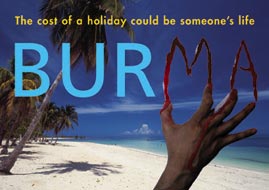
Burma: boycott of Lonely Planet to continue

Boycott Lonely Planet
Some years ago many of us supported a campaign against companies that were encouraging tourism to Burma or indeed were getting products from there. We had some very noteable successes - various key travel and clothing companies withdrawing from Burma. However one failure was Lonely Planet who persistently ignored pleas to stop encouraging tourism there.

Last month Lonely Planet was sold to the BBC so I have written again in the hope that the new owners will look favourably on this issue - in the meantime I have continued to boycott Lonely Planet and would urge others to do the same until we get assurances of a position change. Here is my letter sent to the BBC:

I am very concerned that Lonely Planet publications produces a guide to Burma. Now that BBC Worldwide has bought a 75% controlling stake in Lonely Planet, one of the first things it will have to decide is what to do with this travel guide.

You will be aware that Lonely Planet is on a "dirty list" of companies that Burma Campaign UK is petitioning to sever all business ties with the Burmese economy in order to cut off the ruling military dictatorship's overseas revenue. If you continue to publish the guide then you are taking sides.

The development of hotels, transport and tourist attractions to encourage visitors to Burma is directly linked to mass human rights abuses. Added to this, tourist dollars go straight into the hands of the dictatorship. For these reasons Aung San Suu Kyi, the British Government and the European Union have asked tourists not to visit Burma. Against the weight of this advice Lonely Planet publications continues to promote tourism to Burma through their Burma guide.

Burma's people are suffering under a brutal dictatorship that:

- forces around 8 million people (equivalent to the population of inner London) to build roads, railways and other projects. Forced labourers face punishments including beatings, torture, rape and murder.
- forces more than 50,000 children to become soldiers : a greater number than any other country in the world.
- has 'ethnically cleansed' over half a million minority peoples.
- has refused to hand power to Aung San Suu Kyi's Party, the National League for Democracy : which won 82% of the seats in Burma's 1990 election.
- has made Burma the world's leading producer of heroin and opium.

Other companies like Rough Guides have said they will not publish while the dictatorship remains in power and Aung San Suu Kyi requests tourists not to visit.

The right to life and the right to live without torture and intimidation must come higher than any of our rights as tourists for freedom of movement. Lonely Planets position is impossible to defend. Please reassure me that you will cease to publish the Burma guide.

Others can take action by going to the Burma Campaign website:
www.burmacampaign.org.uk

Or email the BBC direct

27 Nov 2007

Randwick: Potential wall collapse and right-of-way issue

The last blog entry talked about a footpath opposite the Scout Hut - these two issues are just around the corner - again not in my ward but used by residents - first the wall then the right-of-way...

Wall in Westrip Lane near Hawthorne Rise and opposite Red House Farm

Photo: Area of wall previously subject to heave: now relatively safe

The wall has over the last few years become increasingly dangerous. It has been brought to the attention of various agencies and more recently following several complaints from parishioners the Parish have written a further letter and made various phone calls. There seems to have been frustration that the issue wasn't getting resolved so I also wrote a letter last week and we got a good response from the District Council and Highways who set up the site meeting today to look at the wall.

Photo: Looking at previous photos and plans

Problem:
This retaining wall is along a long stretch of the pavement and it is leaning alarmingly and is seriously cracked and has heave problems as well. Many pedestrians use the pavement and in particular mothers with push chairs and young children on the nearby estates taking children to school either at Cashes Green or Foxmoor Primary Schools. There are also two bus stops at each end of this section. The wall is about four foot high - and higher in some places. There is only one pavement on that side of a particularly dangerous road. The danger is compounded by a large hedge planted behind the wall which probably also adds to it leaning and heaving. The issue is made more complex as some owners of the adjoining properties consider (following legal advice) that the wall was never transferred into their ownership when the developer signed off the estate. The wall is in an increasingly dangerous state and may well topple into the pavement and road and in our view constitutes a serious danger particularly to pedestrians.

Photo: Wall leaning at alarming angle

The Building Inspector present showed photos of the wall from about five years ago - the problems were nothing like as bad then - clearly it needs attention now - the first stage is to again contact householders and discuss the best ways forward - the problems of ownership make this particularly difficult issue to resolve - one option may be fort the County to remove the dangerous section and replace with chain-link fencing and allow that and the tree roots to retain the earth. Hopefully this meeting will at least now lead to action to reduce the risks of collapse here.

Right-of-way near the junction between Redhouse Lane and Westrip Lane

Photo: area of concern

The second issue is a patch of land on the same side of the development as the wall but directly on the corner of the junction between Redhouse Lane and Westrip Lane – also allegedly not transferred into anyone’s ownership by the same development company. This has now become an unofficial footpath used by pedestrians including young children, cyclists, moto-scooters motorcyclists etc as a short cut to and from both the Perry Orchard and Hawthorne Rise estates.

The problem is that people come out unexpectedly straight onto a very busy narrow road junction with no warning and little visibility. A number of near misses have occurred at this point. The Parish has been unable to resolve the problem despite contacting various agencies including the Land Registry to identify ownership and thereby bring pressure to bear on the developers, if they still exist as they were last heard of as being based in the Channel Islands - after the original development company ceased trading.

There must be ways to improve the situation: clearly it is a well-used route so blocking it does not seem the right way forward. Improving visibility for vehicles might help as would changing the road surface but again it is a matter of funding priorities - especially as we cannot even establish whether this path is official. Issues like this are deeply frustrating and it seems there are not many options to move forward. What do others feel?

Moves to tackle a dangerous footpath in Randwick

I attended a site meeting today regarding the unofficial footpath that comes out opposite the Randwick Scout Hut (next to Cashes Green School) on Cashes Green Road.

Photo: Richard Huxford, Randwick Parish Chair with Highways officer looking at the unofficial footpath - below other views of path

The official footpath in fact runs parallel to the road for a stretch, but to cut off a significant corner children and adults go under the rail and down a steep slope to join the footway adjacent to the road and opposite the Scout Hut.

Several attempts have been made previously to stop pedestrians cutting off the corner but these have been vandalised - the most recent being a wire fence that has been pulled down. It is the view of myself and Randwick Parish Council that action is needed as the current situation is dangerous. The slope is used by a large number of people coming to the schools and playground - it is steep and when icy or wet leads to people slipping into the path of traffic on the road. This has been witnessed occurring on several occasions.

The Parish have written letters but not had any joy and strictly speaking the footpath is not in my ward - but it is near and residents of my ward use that path - so I also wrote last week - and was able to set up a meeting today with Highways.

The Parish and myself are seeking that the slope be made into a proper path or steps - these could be at an angle to the road to prevent people coming down directly onto the road.

Highways note there is a perfectly good path - with disabled access - so therefore they do not need to act to make a new path - indeed if they do any action they would consider reblocking the cut through to reduce the dangers - although they note that this would likely be vandalised like previous attempts to cut off that route. However Highways have agreed to look at possible costs and possible schemes - it might be that monies can be found from other sources to help pay for the path. We await with interest the next step in improving this situation - and in the meantime hope no one gets hurt on that slippery slope.

I am also of the view that more bulb planting is needed on these verges - I raised this a while back and know the Parish are considering it.

26 Nov 2007

Aussie elections: Peter Garretts' defection?

It is possible Greens will have increased their senate seats to 5 or 6 - good news indeed - however one disappointing piece of news I heard was the defection of former Nuclear Disarmament party candidate and eco-warrior rock star Peter Garrett.

Both the governing rightwing coalition and the Labor opposition are keen to build a pulp mill that would chew up the forests in Tasmania and create pollution. Peter Garrett, as a would-be Labor minister has been arguing that the pulp mill is a beautiful thing, a best-practice, environmentally sound job creation scheme. As Derek Wall writes: "It's like Sting turning up as transport minister here and calling for new runway at Heathrow."

I met Peter Garrett a couple of times when I worked for Community Aid Abroad (now called the Australian Oxfam) managing their Sydney Office - it was back in the mid-80s and I was somewhat in awe of this larger than life bald-headed dynamic campaigner and lead-singer of Midnight Oil. It does seem strange that this radical whom I talked with is now supporting the corporate-friendly policies of ALP - even declaring his support for an American base in Western Australia - quite a change from one who sang: "US forces give the nod/It’s a setback for your country" from the Oil’s 1982 hit US Forces.

Indeed many in the Green movement have been upset by his 'defection/betrayal' and question his credibility - see for example blog comments here and here. By all accounts his move has effected voting - however I hope Greens still manage a strong showing and perhaps once in power Garrett can raise the issues like climate change effectively? In some of his speeches he still seems to understand the urgency of action re social justice and the environment but I will need to see and hear a lot more to be convinced - and certainly evidence like the US base and the pulp mill do not help.

CO2 from 70,000 fires in September in South America

firesandsmokeoversouthamerica

I've just come across this - a NASA satellite image measuring carbon monoxide to show smoke from over 70,000 fires across South America during September 2007. I've pinched the photo from the Biofuelwatch website as this issue is just not getting enough air time. Here is what they write:

"Reports suggest that 2007 has been one of the worst years on record for fires in large parts of South America, including in the Brazilian Amazon, Paraguay, Bolivia and northern Argentina. The biofuel boom is raising commodity prices and large landowners have been burning forest to clear more land for soya. Brazil's sugar ethanol expansion is putting further pressures on the Amazon, too, primarily because it displaces cattle ranching and other agricultural activities elsewhere and pushes them into the rainforest. Recurrent drought in large parts of South America suggests that, due to deforestation, the Amazon forest may be close to the point where it can no longer maintain the rainfall cycle on which it depends, in which case much or all of the rainforest could die back and large parts of the Americas could dry up."

Infact some are nick-naming biofuels as 'deforestation diesel' - deforestation is itself one of the biggest causes of CO2 - all this is giving the reused biofuels - the chip fat - a bad name as one biofuel is much the same as another to the average punter - check them up before you purshase. See also the 'Label' below for previous blogs on this topic.

Discrimination paper to dilute equality duties

The new equalities watchdog - see previous blog re concerns about one appointment - begins work just as the government proposes to sweep away some of the most important advances in recent years.

Photo: Randwick woods before the winds have blown the leaves off this last week

It seems the green paper on discrimination law looks set to dilute duties on public bodies to promote race, disability and gender equality, in spite of - or perhaps because of - the fact that they have begun to prove effective.

The Equality and Human Rights Commission also rightly worries about the green paper's failure to back a new duty covering age, religion and sexual orientation. Age discrimination has been outlawed in the workplace and extending the same principle to services would have huge implications for social care.

Then the government really would have to invest in its future....take dementia as one example - the UK was in the bottom third of Europe in delivering high quality dementia care. This indictment of past failures is set against rising need as the number of people with dementia soars from 700,000 today to over one million by 2025 - the situation is severe. Only a third of people ever receive a formal diagnosis, while those who do, go on to navigate a confusing system characterised by overstretched services, poor carer support and a lack of awareness and training. At least now a strategy on dementia is planned but this will not be helped by this green paper - or for that matter the squeeze on public funds.

And how will we pay for it I hear some as? Well I saw recently a blog entry that asks: "When will Britain accept that it is no longer a colonial power that can organise the world along its own lines and instead start looking after the people who live here?" See blog entry here which includes:

"Earlier this year, MPs on the House of Commons defence select committee were told that the cost of the Iraq war was set to exceed £1bn in 2007. The NHS debts totalled £512m. Make up your own mind where the money would be better spent. While we are on it, the remaining £500m could go towards social care. Practically every single social services department in the land is calling for financial help. Granted, that £500m would be a drop in the ocean.However, when the independent Iraq Analysis Group estimates the cost of the entire campaign in Iraq at nearly £7.5bn so far, there is a feeling that this is the sort of sum that could be invested more wisely. And that doesn't even take into account the new Trident system that has been estimated to cost £76bn over 30 years."

And of course there were calls at the weekend for more dosh for 'defence' - see BBC report here.

25 Nov 2007

Defra cuts will hit Gloucestershire hard

This blog sometimes misses large chunks of my week - too much that could be scribbled here - and probably some think I could keep it shorter as it is......anyway one issue I've not covered here from last week are the cuts to Defra - £300 million that will hit coastal and river flood protection, climate change, canals, animal health - and will bear heavily upon rural counties like Gloucestershire - see my news release last week that doesn't seem to have got any coverage despite the impact on local farmers.

Photo: Cheery local pig

I was also shocked to hear from a local farmer that Defra are insisting that people moving cattle out of the Foot & Mouth zone to a clean zone have to have them blood tested. The test is provided by the same institute that released the virus - and - they have to pay the institute £16 per animal for the test!! (Plus vet charges). As the farmer said: "What an insult!"

24 Nov 2007

Safe Water Campaign meeting

On Thursday I joined our regular meeting of the Safe Water Campaign - see write up of meeting here plus photos.

There were several key issues we are looking at - including our submission to the Nuffield Council, a letter we are writing to the health authority and an extraordinary article in the latest issue of 'Dentistry'.

We also planned the stall - which happened today in Stroud (see photo) - I had my partners granddaughter with me and we had cucumbers, onions and other matters to get at the Farmers Market so didn't help this time with the stall.


Secondary double glazing and listed buildings

I just got an email from Lydia Savage re the article in The Guardian today about secondary double glazing and listed buildings (see below). I have to applaud the Savages for getting coverage of this issue - and indeed the articles' author, David Adam (environment correspondent for The Guardian) for writing about it.

It is an extraordinary situation - at least English Heritage recognise the problem now and look set to act - let us hope it is not too long and that sensible solutions can be found that ensure warm homes and the integrity of the building is retained.

Indeed yesterday I was talking to a designer who was looking at how the stone could be cut out of the stone window frames in one house so that the frame of the new double-glazed windows would be hidden. Clearly this is one way but a huge expense. Most of the existing guidelines were written before we recognised the immensity of the challenge we face with climate change - indeed instead of making it difficult for householders isn't it time we perhaps rewarded them for taking such actions?

David Adam, in the article below, also mentions the solar panels in Bisley - see my blog on 1st August 2007 for a discussion re that issue.

The carbon cost of protecting our heritage


- Listed status takes priority over energy efficiency
- Rules stop homeowners from keeping out chills.

For more than 300 years, people have peered through the window from the kitchen at the front of Richard and Lydia Savage's 17th-century farmhouse near Painswick, Gloucestershire. And for most of the time, they probably shivered. The Savages do what they can to keep out draughts, but even in October the house has a distinct chill. As a result, their central heating system burns twice as much fuel as the average house, and produces twice the carbon emissions.

The couple want to fit modern secondary glazing throughout the house, to bring down their bills and their carbon footprint, but are prevented from doing so because the farmhouse is Grade II* listed, of outstanding architectural or historical interest. And they are not alone - some 450,000 people in England live in listed properties, and millions more face similar restrictions in designated conservation areas.

As ministers urge greater efforts on energy saving and talk of new eco-homes, thousands of existing buildings are being denied basic improvements, and are producing unnecessary carbon emissions.

Tony Allen, a legal adviser to the Listed Properties Owners Club, said: "It has become a really big issue because listed status has traditionally taken priority over a desire to save energy. It's something the authorities are going to have to look at." He deals with three or four inquiries a week from frustrated homeowners.

Walk around the Savages' house and the problem is not hard to diagnose. The walls are thick and the roof well insulated, but the glass windows barely fit their frames. One upstairs bedroom is permanently open to the elements, through a sizable gap left by a former craftsman to vent condensation. To make significant changes, the couple must get the consent of a conservation architect at their local council in Stroud, which follows guidelines issued by English Heritage.

To English Heritage, the imperfections are an example of "a physical survival of our past to be protected for their own sake as a central part of our cultural heritage and our sense of national identity". To the Savages, they are the reason the temperature in their house barely reaches 13C. The Department of Health-recommended minimum for people their age is 21C.

Mr Savage said: "We are in the middle of a conflict between environmental conservation and cultural conservation. If we put in secondary glazing, it is only going to make a very small difference to global warming, but the global answer depends on hundreds of thousands of small differences. The planners see the debate in terms of buildings and we would argue they need to see it in terms of energy efficiency. They talk about saving the houses for our grandchildren, well I want to save our grandchildren from the houses."

David Drewe, who works on energy conservation for English Heritage, said: "We know this is a hot topic and we plan to give a lot more detailed guidance to local authorities next year. There is no such thing as a standard building so it's hard to talk about specific measures, but we are trying to be much more positive towards energy efficiency measures now." He said one problem was that different local councils interpreted the guidelines about what changes were allowed in different ways, so there was little consistency. While some councils allow solar panels, for example, others refuse all requests.

Phil Skill, head of planning at Stroud district council, blames the government for sending out mixed messages. "We don't want to appear unsympathetic, but the government has left us in limbo between two sets of different priorities." He said they were being asked to arbitrate and would like unambiguous guidance.

The council is also in dispute with John Cowen, who has been refused retrospective permission for the solar panels he installed in 2001. The council says they are an eyesore; Cowen says nobody noticed them for six years. He argues that efforts to reduce carbon emissions will be of historical interest, and as such should be protected.

The guidelines

People living in listed properties and conservation areas must get consent before doing anything to their building in case it harms anything that in the government's words "adds to the quality of our lives, by enhancing the familiar and cherished local scene and sustaining the sense of local distinctiveness which is so important an aspect of the character and appearance of our towns and countryside."

In practice this means work to external walls, windows, roofs etc should not alter their character and appearance, though the final decision on consent is left to local councils' planning officers, with the help of bulky guidance notes. On replacement windows, the notes say factory-made double-glazed windows are "almost always damaging" and should not be allowed. Secondary glazing, a less obtrusive window mounted inside the original, is "an acceptable option for some windows". Solar panels are not mentioned, though because they can be removed in future, some councils allow them.

See article here and links to other related articles in The Guardian:
www.guardian.co.uk/environment/2007/nov/24/energyefficiency
Local news: traffic, village shop, poems and big cats

Whiteshill traffic

Just back from the Village Hall where a group of residents and Parish councilors discussed traffic along the main road - it was an open meeting and Chair of the Parish John Rogers (see photo) kicked the meeting off with a series of photos to help the discussions.

Some old ideas to slow traffic were discussed like 'Gateways' to the village - what could they look like? Where could extra benchs go? What about planting? Various new ideas also came up like trying to put in a rural footpath along the road at the top end of the town where walking is lethal - indeed when I canvassed up there or delivered leaflets it was seriously dangerous. The ideas will now go to the Parish meeting and some decisions made about priorities.

Village Shop sale - and fire repairs

This morning I caught the Village Shop sale of crafts - they had just moved inside - forced there by the rain - came away with marmalade and various other bits.

I also heard that the shop are struggling to get a second quote for repairs following the fire there (see photos) - are there any local builders out there that can help? I've phoned a couple this evening but no joy yet - until the shop get the quotes they cannot get the insurance sorted or work begun.

Randwick Gardening Club

I'm told by a member they are taking bookings now for their annual holiday together - it will be in Leeds and 5 gardens will be visited June 30th to 4th July £238 per person.

Randwick Playgroup poems published

Poems are set to be included in the 'Young Writers: My First Poem anthology' - due to be published in February. Apparently they were given sentences to complete with their own words.

Big cats seen in Whiteshill

I just got this report: "A lady was driving at Whiteshill yesterday mid PM and had to slow down due to two big black cats crossing road together. This is in the zone centred on Randwick & Standish woods that's become reliable for sightings. I could do one of my big cat talks in a local village/community hall if you know any local organisations who might want to set this up. The talks explain what's happening with big cats, which species are about, and what the implications are." See my blog on 11th November for details of how to report sightings and email me or leave a comment if you would like someone to do a talk.

Randwick Parish Plan

Sundays meeting which I missed was apparently successful in planning the next stages - particularly looking at the Design statement for the village - more volunteers still wanted - the latest will be soon on the Randwick Gateway site - also with Wap updates.

Savannah Miller in Whiteshill

I just read The Citizen's extra features today and learnt that Savannah Miller lives in our village of Whiteshill.

Photo above of Savannah with sister Sienna from launch of her enterprise - and one below from the Citizen's website

Here's some of what the newspaper writes below - I do remember Sienna being quoted in The Guardian saying: when asked who she would she vote for? "I don't know. I'm a liberal at heart; I don't want to vote Conservative. I'd vote Green, but I know it's a wasted vote or whatever, but it's the only party with integrity."

I hope that with examples like Caroline Lucas MEP and other places where Greens have been elected that it is clear that a Green vote isn't wasted - indeed unless people start voting for what they believe in they are never going to get it - anyhow back to The Citizen....

Fashion designer Savannah Miller is often spotted on the red carpet alongside her actress sister Sienna Miller. But you're much more likely to catch her doing her weekly shop at Stroud's Farmers' Market. As Savannah admits, her life is one of extremes.

The girls were born three years apart in New York and Hong Kong - so life was never going to be conventional. Now, 28-year-old Savannah has been catapulted into the heart of the celebrity and fashion whirlwind, ever since she's launched her fashion label with her younger sister. Savannah, who lives in Whiteshill near Stroud, admits she was expecting the Miller sisters' label, Twenty8Twelve, to be criticised as another celebrity marketing venture.

Sienna, style icon, much- publicised ex-girlfriend of Jude Law, and star of Alfie, Factory Girl and Casanova, with Heath Ledger, is one of Britain's most famous faces and Savannah was worried the critics would get stuck in. But so far, she says, the response has been fantastic. It was never in doubt, really, with her impeccable fashion credentials.

Savannah graduated with first class honours in fashion design and knitwear at Central St Martin's before working for Alexander McQueen and as a freelance designer for clients such as Matthew Williamson, Anya Hindmarch and Betty Jackson.

Twenty8Twelve - named after Sienna's December 28 birth date - brings together Savannah's design skills and Sienna's ideas. They'd thought about working together for years, but it wasn't until fashion entrepreneur Carlos Ortega approached them that the idea came to life. They spent 18 months working on designs - Sienna proved a brilliant fit-model - and now their work is in the shops.

The 2007 autumn collection is a heady mix of Dickensian London, 19th century French peasant and 70s rock 'n' roll New York - with a smattering of Beat poets along the way. It's entitled An Anthology of Rebellion, and fabrics are beautifully-finished denim, luxurious knitwear, perfectly-cut dresses and masculine shirts. Notes and poems are stitched into some of the key pieces - so they immediately become collectors' items. For this collection, they've collaborated with artist David Cooper - he of PO Box art fame.

Savannah is justly proud of their work. "The vision for the label relies on time-old tailoring tecnhiques - sophisticated garments with a vintage feel, but contemporary vibe and strong directional design," she says.

At the start of each season, the sisters head off to Paris to scour the vintage markets for inspiration and brainstorm ideas for their look book. Their ideas and styles complement each other with Savannah describing Sienna as "younger in spirit" and someone who comes up with "crazy" ideas. "I'm quite an old lady really," Savannah giggles. "Sienna brings a youthful, slightly more edgy aspect to the design process."

Once they're back from France, Savannah gets stuck into the groundwork of making each design a reality. She's currently working on Twenty8Twelve's winter 2008 collection. Summer 2008, inspired by the vintage style of Vita Sackville West and other literary icons, is already in production.

Twenty8Twelve aims to produce quality, beautifully- finished clothes which are the antithesis to high fashion mass-produced clothes - much of which has, ironically been inspired by Sienna. "A lot of what Sienna was wearing was being copied and it was quite weird," said Savannah.
"It made her think 'where's your individuality?' Women need to feel that they can dress for themselves and wear clothes in their own way."

But for Savannah fashion is only half her life - she spends three days a week in London before returning to family life in Stroud with her two-year-old son, stepson and husband Nick.

Savannah says she lives in a "unique reality". "I don't think I can exist solely in either situation," she says. "I'm quite an extreme person. I like going to London and getting really involved and I also love being able to get completely away from it," she says. Although she does admit to being constantly in touch with home and work via her Blackberry.

Savannah moved to Stroud from Devon, partly to be closer to London, but also because the town and its surrounding countryside offered a way of life which suited her family. And she's in good company too - Robin Hood actor Keith Allen and Britpop artist Damien Hirst have all bedded down in the Stroud valleys. Zara Phillips and Mike Tindall have a cottage on the Gatcombe estate and bonkbuster novelist Jilly Cooper is just down the road in Bisley.

"I love the Stroud farmers' market and the personal touch you get there," says Savannah. "We're so lucky to have it here. It's probably the best market I've ever been to in the world."

Stroud suits her down- to-earth side - she doesn't own any designer clothes, other than a few gifts from Sienna, and says she shops at H &M in Gloucester. Country living gives her a healthy dose of reality to contrast the chi-chi world of London fashion. "You can go mad working in the fashion industry. It's all consuming," she says. And although she says Twenty8Twelve is here to stay, she has an alternative career up her sleeve for when it really does get too much. She is training to be a doula - or birth assistant.

"I want to eventually make it my career," she says with a smile. "I love fashion but I can't see myself doing it when I'm old and grey. I really believe there's not enough support for women when they give birth. I had an amazing birth and was very inspired by that. Birth can be a very empowering - and disempowering - experience. It's a time when you really need to feel empowered."

But for the time being, her double life of Stroud mum and London designer suits her well. As she says: "It's unreal - but it's also quite fun."

Ruscombe field plots still being sold?

I was sent an email this week from someone wanting to find out more regarding the fields at Ruscombe - they included plans and several photos including this one here. They were interested in a plot on the site and whether it would be a 'good investment' - I wont comment on that but I know the community will fight tooth and nail to ensure no houses are built on this land, that there is cross-party support against any development on those fields, that the Local Plan (which we have to adhere to) makes clear no development for this site, that the fields are in an AONB.....I could go on - anyhow I have left a message for this person if they want to talk more about my views on this.

It is worrying that land is still being marketed in this way - while perfectly legal it is clearly wrong in my view on many counts. The Ruscombe Valley Action Group will continue to to support moves to stop the practice of landbanking.

See more re landbanking on this blog here - and our action group's statement on the Parish website here.

UK’s first organic carp farm

Channel 4’s River Cottage food guru Hugh Fearnley Whittingstall gave the UK’s first organic carp the thumbs up as a tasty sustainable alternative on Thursday.

Photo: Jimmie who used to live near Nailsworth at his Devon Carp farm

See my blog re 21st August 2007 for more re my visit.

In the last of three progammes on fish: ‘Gone Fishing’ Hugh visits all too briefly the pioneering carp farm in Devon which has grown its fish almost entirely on locally sourced organic feeds. This is in stark contrast to virtually all other fish farms in the UK. These farms, as I've noted previously on this blog, use highly processed fish pellets that contain a significant proportion of wild caught fish originating from many areas of sea where fish stocks are seriously threatened. Hugh cooked the carp for an invited taste panel which rates the fish very highly and also explores the idea of growing carp in your own pond for your table.

The organic carp project at Upper Hayne Farm. Devon is the brain child of husband and wife team: Jimmie and Penny Hepburn who used to live in Burleigh just outside Nailsworth. The fish are reared at low densities in carefully managed ponds which produce much of the carp’s feed naturally (e.g. daphnia). Additional feeds are also given to the carp including meal worms, compost worms and locally sourced wheat grain. A week before harvest, the carp are transferred to natural spring water which thoroughly cleanses the fish and allows the true taste of the carp to be revealed.

The Hepburn’s carp is the first in the UK to be grown to the Soil Association’s organic standard for carp. The farm is planning on harvesting the first organic carp during 2008 and supplying restaurants, shops and Farmers Markets.

The demand worldwide for fish is increasing, however three quarters of the worlds fisheries are either fully or over exploited (FAO). Aquaculture is increasingly playing a key role in supplying this demand, indeed globally, it is the fastest growing food sector. Here in the UK, it is mainly carnivorous fish such salmon or trout which are farmed. The farming of these species can have a significant environmental impact such as their dependence on wild caught fish which is further threatening wild stocks. An alternative is to grow a species such as carp which occupies a lower level in the food chain requiring less energy to produce the fish protein. In fact more carp are farmed worldwide than any other group of fish – much of this takes place in Asia but also in central and eastern Europe. Although carp were grown in the UK in Medieval times the rapid development of the sea fishing industry led to the taste of carp and other course species to be lost and today carp are only regarded as a sport species.

We have come full circle, it is now important that we not only farm more fish but that we do it as sustainably as possible. This trail blazing project along with Hugh Fearnley Whittingstall’s approach demonstrates what is needed to produce a fish which tastes good is much more ecologically responsible and you can even grow the fish yourself!

If you are interested in the project/venture and would like to find out more please contact:
Jimmie & Penny Hepburn 01823 680888 www.aquavisiononline.com

23 Nov 2007

Buy Nothing Day tomorrow

Buy Nothing Day - Saturday 24th November will see people around the world take part in Buy Nothing Day - attempting not to buy anything for 24 hours. Described as a 'challenge' to consumer culture, Buy Nothing Day aims to highlight the environmental and ethical consequences of consumerism.

I have supported this day on many previous occasions (see here) and indeed applaud it's sentiments. However tomorrow I will be supporting a sale in our local village shop in Whiteshill in the morning and hope to also go to the Farmers Market (just been awarded as best in country) - have uncharacteristically not been for some weeks and the cupboards are also very short of anything fresh.....but let us hope the day will make us all think before we buy.

Green Party Principal Speaker Dr Derek Wall comments: "People often ask me - how to be Green? It's really very simple, and requires no expert knowledge or complex skills. The answer is this: Consume less, Share more, Enjoy life. The root cause of so many of our problems - from climate change to garbage mountains and species loss - is over consumption. It is a cold fact that we cannot consume more and more, the waste mountain will suffocate our children and rising temperatures will make life on planet Earth unbearable. Yet trillions of dollars are spent every year to persuade us to buy more stuff. The present high growth capitalist economy is unsustainable. I am backing Buy Nothing Day on Saturday and I often have my own buy nothing days. We need an economy based on making things that last longer, enjoying what we have and being less driven by addictive consumer behaviour promoted by out of control corporations. That great green author Erich Fromm said it all in his book title 'To have or to be', we need to think about what we do, not base our identity on shopping alone. I am calling on all greens to consume a little less and live a little more."

Let us not forget that the UK is already more than £3,000,000,000,000 in debt yet the shopping centres and landfill sites remain full to bursting.

Airbourne lidar opportunity for Randwick?

Airborne LIDAR - well I have to confess I'd never heard of it until the beginning of this week - Light Detection And Ranging - it measures the height of the ground surface and other features in large areas of landscape with a resolution and accuracy hitherto unavailable, except through labour-intensive field survey or photogrammetry.

Photo: comparing lidar and google on computer and below closer detail of lidar

It provides highly detailed and accurate models of the land surface at metre and sub-metre resolution - operating by using a pulsed laser beam which is scanned from side to side as the aircraft flies over the survey area, measuring between 20,000 to 100,000 points per second to build an accurate, high resolution model of the ground and the features upon it.

The Parish of Cranham have a project to survey a large area (costing many thousands of £££) and for a mere £2,500 extra they would consider Randwick and Standish area. One parishioner attended the talk at Cranham this week and was impressed by the incredible detail and versatility of this stuff - 'stuff' - oh dear my descriptive powers are failing me this evening - anyhow he contacted me and he kindly invited me to view LIDAR in action on his own computer yesterday.

It was certainly impressive giving vertical resolutions of only a few centimetres - perfect for a vast range of projects - particularly archaelogical research and flood modeling. One map showed the site of an old triangular Roman fort - particularly interesting as the road it was on has always been known locally as the Roman Road - it also showed at another site that instead of three separate forts there was only one - indeed it was leading to a rewriting of archaeology for that area!

It would be very wonderful to do the same here - particularly looking at the ancient sites in the local woods (see previous blogs re barrows). Plus it could be used for a multitude of other purposes - flood modeling to mapping toxic fumes from a possible explosion at a plant and much more.

I have since spoken with Parish councillors and also officers at the District Council - they had a very helpful guy there who was a mapping expert - I learnt that LIDAR data was used by the EA as part of the detailed planning for the canal line. However the District Council take height data from a company called Intermap - not as detailed as the LIDAR data and wouldn't be suitable for detailed analysis such as the very detailed flow modelling and archaeological applications. SDC have however used it for 3D visualisation purposes (e.g. for the Brimscombe AAP) and for planning applications relating to masts and turbines. In these planning cases they create a 'viewshed' - a layer that shows all areas of land that the structure can be seen from.

So where are we - well the cost - it's very expensive - SDCs aerial photography for Stroud District was about the same price as quoted above for Randwick parish - but then this is something quite different. The stuff (oh dear there I go again with my descriptive powers) takes up huge amounts of disk space to store (because of the detailed resolution) - and apparently software applications that handle LIDAR are expensive and need to be used in conjunction with very high powered computers.

Is there anyone in the Parish interested in taking this forward? The Parish Council members I have spoken to are interested - so are the local Historical Society - but I doubt they can proceed when we are talking £2,500 - then of course we need a group to follow up to analyse the stuff (OK last time I mention stuff) whether it be archaeological or flooding or whatever if we are to proceed we need to act quickly as surveying must start in new year when no tree cover.

Further resources:
LIDAR general - go to:
http://en.wikipedia.org/wiki/LIDAR
LIDAR Archaeological Applications - click here.

Peoples Navy sets sail: sign petition now

Please consider signing this pledge to support the Peoples Navy which will set sail to highlight the disgraceful treatment to the Chargossian people by primarily the UK government, and support their right of return. This is an issue I have followed for some time but it has rarely got into the news - let us hope this exciting move will lead to more coverage and action. Visit http://peoplesnavy.com/

To sign the petition
To follow the fleet
To spread the word

See update at bottom of this post re the gloomy news - Meanwhile a post from the New Statesman sums up the situation well - here's the link:
http://www.newstatesman.com/200711200001

Infact as the New Statesman carry a link to this blog I hope they wont mind me reproducing the article here (meanwhile visit the New Statesman for other great articles!):

Don't mention the Chagossians
Sean Carey
Published 20 November 2007

A resolution to the long-running British injustice to the Chagos islanders could have signalled a switch in UK foreign policy

The dawn of the Brown premiership could have heralded a shift in British foreign policy by resolving the long-running injustice to the Chagos Islanders. It is, after all, more than 40 years since these people were evicted from their Indian Ocean home by the UK so the Americans could build an airbase. Such a move would have had the additional advantage of introducing some political distance between London and Washington.

It might even have gone some way to revitalising Brand Britain which has undoubtedly suffered badly - both inside and outside the country - because of Iraq. But it has now become obvious that even with the selection of left-leaning, senior figures like David Miliband and Mark Malloch Brown at the Foreign and Commonwealth Office it is, for all practical purposes, business as usual.

Gordon Brown, unlike his predecessor Tony Blair, may not always be on the phone to George W Bush but it is clear that he is still a staunch supporter of the "special relationship".

Indeed, in his Mansion House speech on foreign affairs, the British Prime Minister declared that he regarded America as the UK's most important ally in re-energising international institutions like the United Nations in order to tackle a range of 21st century problems - from climate change and trade reform to nuclear proliferation, global terrorism and flu pandemics.

The Chagossian issue wasn't mentioned in the Guildhall speech. Why would it be? One suspects that at the lofty heights of global government from where Gordon Brown aspires to operate he would think -- if he thinks about it at all -- that the exile of the Chagossians from their homeland in the Indian Ocean is all a bit unfortunate but, that when the political arithmetic is calculated, some sacrifices, preferably by the "little" people, are sometimes required to sort out the world's "big" problems.

Maybe this is what the British Prime Minister had in mind when he used the now much commented on phrase "hard-headed internationalism" in his speech at the Guildhall. But sometimes politicians can be a little too hard-headed. Indeed, there is something peculiarly cruel about the way the British government's legal juggernaut has set off once more to crush the hopes of the Chagossians who have already won a series of victories in the courts allowing them the right of return to the islands of Chagos archipelago which were illegally detached from the colony of Mauritius three years before its independence in 1968 and now form part of the British Indian Ocean Territory. . No sooner do the Chagossians achieve victory in one legal case, than the government appeals and the heavy, legal machinery once again clunks into gear.

And this time the reason, as the Foreign and Commonwealth Office spokespeople are very keen to explain to anyone prepared to listen, is that there is an urgent need to define the defence status of all British overseas territories including Bermuda, Gibraltar and the Cayman Islands -- not just the British Indian Ocean Territory, you understand -- because of the Court of Appeal judgement in May this year which ruled that the British government had abused its power in evicting the Chagossians from their paradise islands. All this legal manoeuvring very conveniently prevents the islanders returning to their homeland, of course.

Meanwhile, over the last few months the Americans have been busy upgrading some of the aircraft hangars at the Diego Garcia base in order to accommodate the B-2 stealth bombers -- equipped with new 30,000 lbs bunker-busting bombs -- that will relocate to the island from the Barksdale base in Missouri if President Bush decides to authorise military strikes against suspected illegal Iranian nuclear facilities.

And the legal moves undoubtedly buy the British government more time. Indeed, there must be a hope in London that as more and more of the original 2000 inhabitants of the Chagos Islands grow older or die - there are around 850 still alive, 700 in Mauritius and 150 in the Seychelles - the Chagossians' campaign to return to their homeland will lose momentum. By and large, elderly people don't make good campaigners and dead ones don't campaign at all.

The Chagossians may be perceived in some quarters as small players in the great scheme of things but to ignore their legitimate plea to return to the archipelago after so many victories undermines the legal process -- its spirit if not the technical aspects, anyway -- and is immensely damaging to the UK's image abroad.

This argument was powerfully put by David Snoxell, the former British High Commissioner to Mauritius, 2004-06, in a letter to The Times three days before the government made its announcement on November 6 declaring that it was going ahead with its decision to appeal to the House of Lords to seek clarification about the status of its overseas territories.

"Apart from the legal costs, which have to be funded by post closures in Africa, the UK's reputation for defence of human rights and basic freedoms is brought into question," he wrote. "For the British government to be pursuing a case that denies the Chagossian community its fundamental right to return to its homeland, a right that has been restored by our courts at each level over the past seven years, puts us on par with those countries we condemn for lesser human rights violations."

Olivier Bancoult, the leader of the Chagossian exiles in Mauritius, takes a similar line. "Why is the British government always lecturing the rest of the world about human rights when it ignores the human rights of the Chagossian people? We have already won twice in the High Court and again in the Court of Appeal so why do we now have to go to the House of Lords and waste even more of the British taxpayers' money?" he asks.

These are simple questions which do not require the sophisticated legal responses that will no doubt be delivered by the Law Lords next summer. In the meantime, perhaps Gordon Brown or his ministers David Miliband and Lord Malloch Brown might like to answer them.

UPDATE: Shocking news Oct 2008 - see Guardian article here - Chagos islanders evicted by the British government in the 1970s today lost their long-running battle to return to the Indian Ocean archipelago.

22 Nov 2007

Government transport policy based on oil at $35!

This week's Signal Failures - Private Eye's news of c***ups in the transport world) highlights the entertaining little factoid that the Governments' 'model' used for the 'predict' side of their 'predict-and-provide' transport policy (Called the NTM or National Transport Model) uses an oil price scenario of (wait for it...) $35 (at 2004 prices) by 2010.

Yesterday the barrel price for oil was barely a few cents away from hitting $100. We can now see why the Government thinks widening the M25 etc is a goer while electric trams in Leeds would be a dead loss. You also have to wonder if any of the people involved in this work actually pays for their own transport...

Latest IPCC climate report: climate change worse than ever

"Warming of the climate system is unequivocal," warned the Nobel Prize-winning Intergovernmental Panel on Climate Change in its fourth and hardest-hitting report yet. Just released on 17th November - the peer reviewed analysis of 2,500 of the world's top climate scientists....

Photo: Randwick woods

The new report is intended to be a guide for policymakers - particularly the ones who'll be meeting next month in Bali, Indonesia, to begin hammering out a new treaty to pick up where the Kyoto Protocol leaves off.

Delegates from more than 140 countries came to agreement on the document, which summarizes three previous reports and warns of the grave dangers posed by climate change. Scientists reportedly managed to fend off efforts by U.S. representatives and others to weaken the report - however many experts say the final version still doesn't capture how bad the situation really is. Hans Verolme of WWF, for example, said: "The IPCC is a five-year process and the IPCC is struggling to keep up with the data. And the new science is saying: 'You thought it was bad? No, it's worse.'"

Here are some of the bits from the report which local climate campaigner Kevin Lister extracted:
- Eleven of the last twelve years (1995-2006) rank among the twelve warmest years in the instrumental record of global surface temperature (since 1850).
- Atmospheric concentrations of CO2 (379ppm) and methane (1774 ppb) in 2005 exceed by far the natural range over the last 650,000 years.

- Of the more than 29,000 observational data series, from 75 studies, that show significant change in many physical and biological systems, more than 89% are consistent with the direction of change expected as a response to warming.

- Carbon dioxide (CO2) is the most important anthropogenic green house gas. Its annual emissions grew by about 80% between 1970 and 2004.

- Continued green house gas emissions at or above current rates would cause further warming and induce many changes in the global climate system during the 21st century that would very likely be larger than those observed during the 20th century," (potentially up to an unimaginable 6 deg C increase)

- Anthropogenic warming and sea level rise would continue for centuries due to the timescales associated with climate processes and feedbacks, even if green house gas concentrations were to be stabilised.
- Model projections suggest significant extinctions (40-70% of species assessed) around the globe.

- Early mitigation actions would avoid further locking in carbon intensive infrastructure and reduce climate change and associated adaptation needs.


How much more evidence is needed to convince people that we cannot expand Staverton or any other airport?

Devon: surfers and Napoli

Having been away in Devon for a couple of days I thought I'd do a quick round up of some of that visit...first up Woolacombe - my first proper visit to this village that has the 'most beautiful' beach in North Devon - it was very lovely and had a great walk on it..

No surfer clubs in schools?

I did talk some to local shopkeepers and one thing that astonished me was that local schools apparently didn't have surf clubs - is this really right? Surely schools should be supporting this - the economy of this part of Devon relies heavily on surf tourists and locals....in Australia schools support surf clubs hugely.

Artist Martin Procter

Enjoyed this artist's work in a gallery in Beer (see left) - apparently he claims to have been strongly influenced by Cotswold artist John Blockley.


Napoli still causing problems

My parents live in Colyton so a walk on the beach at Beer revealed the Napoli still there (see photo) - apparently Europe's largest crane is booked for next year to continue dismantling it - hopes had been for work to finish before Christmas.

Be one of 40 homes to cut energy use

Stroud District Council have just released this news release below - I would urge people to apply - while I would prefer to see more focus on energy saving measures to all this project is now up and ready to run - go for it!

Photo: Randwick woods

Wanted - forty homeowners with a passion for saving energy and a willingness to work in a team. In an exciting new initiative, Stroud District Council is aiming to show that existing homes CAN achieve a massive 60% reduction in CO2 emissions.

Under the scheme - named Target 2050 - the forty homes will be subjected to an in-depth energy usage survey, after which an individual action plan for reducing emissions will be drawn up. Owners will get expert advice to support them in carrying out their action plan, including free energy saving gadgets.
The scheme takes its name from the government target to reduce the UK's CO2 emissions by 60% by 2050. The forty homeowners taking part in Target 2050 will be selected on the basis of ensuring a representative mix of housing types, location and number/age of inhabitants.

To start with, Target 2050 will run for three years. Twenty of these households will be invited to have an Ecometer fitted, to monitor their energy use in detail and in particular, how changing habits can help to maximise energy savings. These households will also be expected to become case studies, with a willingness to work with others to show what can be achieved and inspire other householders to take action.


"This is a big challenge," says Cllr Elisabeth Bird, the Council's Cabinet Member for the Environment. "We are looking for people who are serious about reducing their carbon footprint - serious enough to change their behaviour and invest in home improvements - with some help from us."
Target 2050 is the only scheme of its type to be running in Gloucestershire. Stroud District Council is committed to investing £400,000 over the next three years to improve home energy efficiency. This was one of the pledges contained in the Council's Environment Strategy, launched last year. The project is managed by Severn Wye Energy Agency. There is no restriction on the types of property which will be considered for Target 2050 - even listed buildings are eligible. The emphasis is on getting a range of different property types that reflect the profile of the district's housing.

Anyone interested in joining Target 2050 should call Gloucestershire Energy Efficiency Advice Centre on 0800 512 012 (eeac@swea.co.uk) as soon as possible for more information and an application form. Successful applicants will be notified by 7th January.

Poppies, Iraq and refugees

The BBC phoned just as I was going away to family for a couple of days - they wanted an interview me as to why I wear both red and white poppies - they had picked up a previous blog item (see label below for more info) - unfortunately I missed the chance but did pass it onto someone else.

I have to say I find opposition to white poppies very strange - a minority seem to misunderstand them -one letter in the The Citizen even said: “wear your poppy with pride unless it’s the white variety usually sold in Stroud town centre – then wear it with shame.” The writer should know better - John Marjoram wrote a reply - see it here. I have discussed this issue before on this blog so wont repeat here otherthan to say that the White Poppy symbolises the belief that there are better ways to resolve conflicts than killing strangers.

However
Remembrance Day did get me thinking about Iraq - an issue I've not touched on for a while - it is still going on - it did seem extraordinary that no one mentioned Iraq - no one even mentioned the fallen of that country - I am only today catching up on emails and came across this link of a Pilger article on this subject. It is worth a read to remind us of the pain and horror of what is happening in that country.

One shocking fact is the number of refugees - as many as 5 million have now fled their homes but half of those are unable to leave the country - see article here. Those who cannot find refuge with relatives or friends are forced to live in temporary camps which have sprung up across the country. Accurate figures are extremely difficult to come by, but according to the Iraqi Red Crescent Society (IRCS), two million people are now displaced within Iraq, while UNHCR indicates that another two million are refugees outside the country. Neighboring countries are increasingly closing their borders to Iraqis, suggesting that the number of displaced seeking shelter within the country is unlikely to fall in the weeks to come.

Why no media coverage of refugees?

You would think this would be big news but it seems that it is barely been mentioned - a suggestion in an email to me is that we should write to the news media
and ask why:

(1) They are not reporting on the huge refugee crisis in Iraq. The Iraqi Red Crescent Society (IRCS), claim that two million people are now displaced within Iraq, while UNHCR indicates that another two million are refugees outside the country.
(2) there has been no in depth reporting/ investigation on the number of Iraqis that have died as a result of the illegal Anglo-American invasion. The Lancet published research by the John Hopkins University and al-Mustansiriya University in Baghdad which calculated 655,000 Iraqi death. The British research polling agency, Opinion Research Business, has extrapolated a figure of 1.2 million deaths in Iraq.

You can either phone, write a letter, or send a email to the media outlet concerned:

BBC complaints
http://www.bbc.co.uk/complaints/

ITV complaints and comments
http://www.itv.com/ContactUs/wheretofindus/default.html

Channel 4 Comments
Click here

Sky News Feedback
http://news.sky.com/skynews/contactus

Channel Five Feedback
http://www.five.tv/aboutfive/contact/general/

21 Nov 2007

Dobells' in Cheltenham is site for Staverton discussion

staverton1Dobell's pub Monday night was the meeting place for a collection of campaigners looking to stop Staverton expand - various groups represented including Green Party, FoE, CASE and the campaign group 'Plane Stupid' - I have heard it said that to be considered a true 'Cheltonian' one has to have been born within the sound of the 'Dobells' - anyhow we kicked off with a look at how we all felt Camp Hope had gone...

To my mind Camp Hope was a bit of a turning point - 5 years ago I raised the issue re the proposed expansion - the airport has tried to deny they are expanding - even tried to deny climate change existed - now with their planning applications this year they can no longer deny expansion plans - indeed already they have extra scheduled flights: their CO2 emissions are on the rise. I had a letter in the Western Daily Press yesterday on this topic (see here).

Camp Hope was significant in that it is an indication of the wide level of support - I had loads of emails sent and many didn't go but the demonstration raised the issue. It also brought together campaigners from various organisations who can hopefully reach people more effectively together.

I can't discuss all meeting here but other topics included:
- the link between the airport and cancers in the community - I've mentioned this before on this blog and the evidence is not very conclusive either way. To my mind there are enough arguments without needing to also use this.
- recent media attention has been concentrating on the protesters rather that the airport. This maybe a human interest angle but detracts from the important message re climate change - and for that matter other issues like noise, pollution, traffic etc.
- feedback from the SW Green party meeting in Bath which was open to all campaigners to discuss SW airport expansions (several from Glos went): hopefully a new email list to be set up soon - anyone interested let me know.
- Cheltenham Borough - several questions were submitted to the last scrutiny committee meeting. Meetings have also been held with some councillors and Martin Horwood MP. He stated that his position is no longer that “the changes are safety related and are not expansion” - he now has an open mind. Campaigners also met the prospective Conservative candidate for Cheltenham - no firm commitment re a position.
- Gloucester City - discussion about how best to ask questions.
- Tewkesbury planning committee - still no date for application to be seen.
- Various actions have been suggested to continue to highlight the moral, environmental and economical madness of airport expansions.

Infact several calls to make now - any blog readers interested in getting involved more do contact me....

Write to Ministers re Cashes Green Hospital site

Just sent the following letter below to Ministers Hazel Blears MP and Yvette Cooper MP - see my blog on 15th November for background. I also raised this project with Randwick Parish Council last week - they are the neighbouring Parish to this project and have a strong interest in seeing the site is put to good use - they are now looking to also write a supportive letter of the GLP plan.

I would strongly urge others to write letters of support.

The latest news is that this hinges on the Value For Money case - GLP hope to engage a consultant to put together the arguments - apparently the Treasury has been caught short in the past with money from old hospital sites - but surely even a brief look at GLP shows this exciting pilot scheme is a win win situation....

Re: Cashes Green Community Land Trust pilot project

I write on behalf of Stroud District Green party who have 11 out of 18 seats on Stroud Town Council and 5 Stroud District Council seats including my ward that neighbours the Cashes Green Hospital site.

We are deeply concerned to hear that English Partnerships has reversed their decision that the former Cashes Green Hospital site be transferred to Gloucestershire Land for People for urgently needed permanently affordable homes, allotments, social rental homes and community facilities.

GLP's innovative proposal for the 11-acre former hospital site was developed thorough considerable open consultation and engagement with the local community. This resulted in the particularly exciting proposal, which included carbon neutral houses, good social design, significantly lower entry prices for home ownership and permanent affordability through Mutual Home Ownership and retaining the land value in the community land trust (CLT).

It was our understanding that the English Partnerships' Hospitals Disposal Board welcomed GLP's proposal in June 2007 and that there is cross-party support for the principles of CLTs. We also understand that the government hopes to increase the number of affordable homes, encourage moves towards carbon neutral housing and have specifically identified CLT's as part of the flagship community engagement policy.

Why then has there been this change of direction? We would urge you to give GLP your full backing and send a strong message that the government is supporting local communities. To significantly change this scheme now, after so much consultation and work with the community, would be unforgivable.

I hope very much you will be able to clarify the situation and give this project a clear message of support.

Cllr. Philip Booth, Stroud District Green Party

19 Nov 2007

Stroud Farmers Market is best in country and update on Heinz campaign

MarketVarious food related updates in this blog entry...Farmers Market, Heinz, Tesco and GM:

Stroud Farmers' Market which started in 1999 has been named the best in the UK. The market which has more than 45 stalls each Saturday has been awarded the Certified Farmers' Market of the Year 2008 by FARMA - the National Farm Retail and Markets Association. Huge congratulations must go to Stroud market organisers, husband and wife team, Kardien and Clare Gerbrands.

Clare is quoted in The Citizen saying: "We are delighted. The customers will be so proud and so will the stallholders. We are kind of floating really. We never thought we could win it because Stroud is such a small town." Last year, the award went to Edinburgh.

The "unique community experience" offered by Stroud Farmers' Market clinched this year's award of the FARMA engraved market bell. The judges' citation read: "Farmers' markets are lively and personal, and none more so than Stroud, where organisers use a dizzying mix of innovation, marketing, publicity and retail skills to weave a unique community experience. For being at the leading edge of everything about farmers' markets, energy and commitment, Stroud is the national winner 2008."

Update on Heinz campaign

See previous blogs by scrolling down - 5th and 10th October - Heinz have now responded to pressures to remove their new Farmers Market soup range - they will change their labels saying that the products are made from the UK and other countries and also say they are "Inspired by farmers markets" on the front of the tin - this is still nonsense and goes no where near far enough. As Clare said previously: "Everything is fresh and local at farmers' markets - and that soup is neither. There's no reason for Heinz to be using the name Farmers' Markets - they are nothing to do with farmers' markets."

The campaign is now moving to expand and go national with petitions and also to urge people to write to the Advertising Standards and not buy the soup.

This seems a bad move by Heinz who will receive plenty of adverse publicity about this...

Last Tesco-free town under threat

Meanwhile I was astonished to learn that Harrogate is one of only four places in the UK not to have been colonised by Tescos - the others are the Shetlands, Orkney and the Outer Hebrides! Harrogate is now under threat - read more here.

GM funding revealed

The massive funding of GM by the Government has been revealed - £50m per year for biotech industries while only £1.6m goes to organic farming. Read local Green party letter here.

This comment re the Farmers Market award was also in The Citizen:
IT'S MY FOOD NIRVANA

National food critic Matthew Fort, who lives in Stroud, described the market as his 'personal food nirvana'.Mr Fort (pictured) wrote in his column in the Guardian on Saturday about the market. He said: "One of the markets covered by Fork is my personal food nirvana, Stroud farmers' market, where this column began all those calories ago. The market has gone weekly but lost none of its energy. I bought duck legs to confit, a couple of lamb breasts and a bag full of less usual apples."